B
A home is much more than four walls and a roof. It is the place where our personal stories show. It suggests who we are,what we love and the journey we've taken through life. At the same time,it reminds us of the times we live in. With this in mind,CGTN invites you to step into The Gateway of Time with an immersive visit to homes that shows the changes of Chinese living across the years. Using AI and AR,we invite you to have a time-travel to some homes set in three periods of China:the early years after 1949,the period after reform and opening up,and the modern day. Click here with your finger,and then let's start a historical journey.
As you enter,the first of the three homes you see is a northern Chinese village house from 1955. There is a traditional heated platform called Kang along with a set of farming tools which suggest this home belongs to a farmer. There are also some toys lying around.
The year 1955 in China was a time when most of the people lived in the countryside and the urbanization rate(城镇化率) was really low. Most of the people worked in the primary industry and the GDP per capita(人均 GDP) was 150 yuan that year,but the disposable income(可支配收入)of rural residents(农村居民) was less than half that number.
The second home is an apartment set in a big city in 1999,about 20 years after the introduction of the reform and opening-up policy in the country. The apartment is the home of a young factory worker and his wife,who is a primary school teacher. The man's parents have a background in farming,but they now spend most of their time here with their son and daughter-in-law.
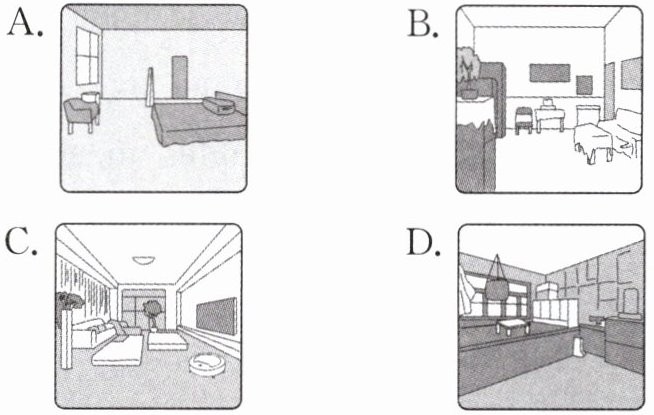
The last of the three homes is a modern Chinese home today. This smart home belongs to a young software engineer who lives here with her parents and grandparents. It is a time of prosperity(繁荣) for this family as the young engineer is progressing rapidly in her career while her father runs his own trading business and her grandparents spend their days feeling proud of their achievements.
This was a time in China when people
saw huge improvements in living standards as homes became bigger and equipped with modern things like washing machines and televisions. The cities grew rapidly,with people in the city getting a little over 8,300 yuan a year.
Entering The Gateway of Time,each home you see tells more than just how people lived. It shows how the hopes,dreams and lifestyles of Chinese families have developed. It is not just an exploration of physical spaces,but a close touch of the Chinese society.
5. Which picture may be the home of the software engineer in the passage?
A.
B.
C.
D.
6. Which of the following “saw/see/seen” has the same meaning as the “saw” in Paragraph 6?
A. I think that he
saw the main idea.
B. She looked for him but couldn't
see him.
C. I
saw a TV programme last night.
D. This sports hall has
seen many football games.
7. What can we infer from the passage?
A. The travel offers a better understanding of how Chinese society has developed.
B. The technology of AI and AR makes it possible to have time travel.
C. The disposable income of rural residents was 75 yuan or so in the year of 1999.
D. Users can go back to ancient times to experience how people lived and worked.
8. Where can we find this introduction?
A. On a website.
B. On a radio.
C. In a magazine.
D. In a newspaper.