B(2026·无锡侨谊实验中学阶段检测)
The Story of “Yuan Dan”: Then and Now
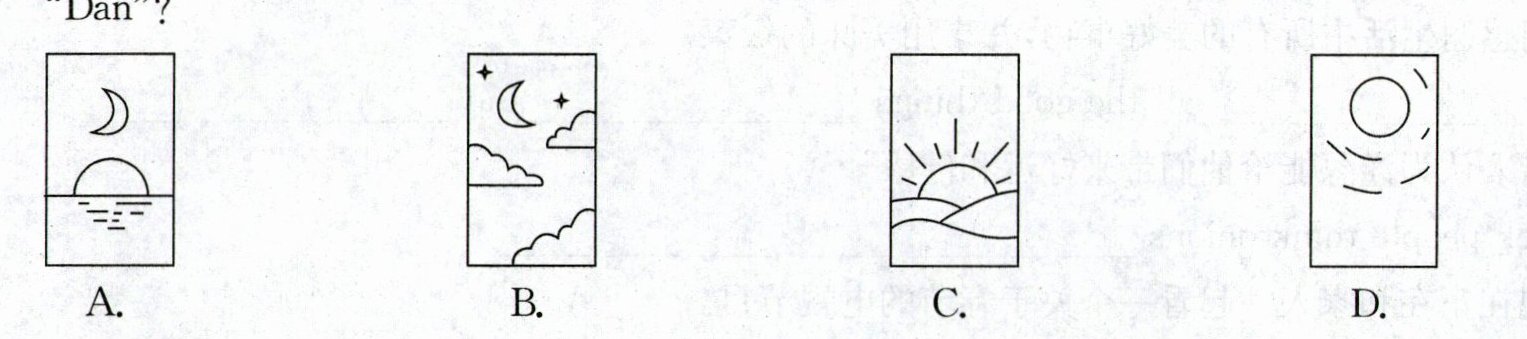
In modern China, 1 January is celebrated as “Yuan Dan”. The name carries deep meaning. “Yuan” means “beginning”, and “Dan” means “dawn”. The character “Dan” looks like the sun rising above the horizon. Thus, “Yuan Dan” poetically translates to “the first sunrise”.
Historically, however, this term did not refer to January 1st. For thousands of years, it described the first day of the Lunar New Year. The specific date often changed depending on the ruling emperor. For example, the Xia, Shang, and Zhou Dynasties all started their years in different months. It wasn't until the Han Dynasty that the date was fixed to the start of the lunar spring.
The modern definition appeared in the 20th century. In 1912, China adopted the Western Gregorian calendar to match the world. Later, in 1949, the government officially
separated the two holidays: 1 January became “Yuan Dan”, and the traditional lunar celebration was renamed “Spring Festival”.
Interestingly, the date of 1 January comes from ancient Rome. In 46 B. C., Julius Caesar set this date to honour Janus, the god of beginnings, who looks both to the past and the future.
4. 新考法 图片理解 Which of the following pictures best describes the meaning of the character “Dan”?
5. Which dynasty fixed the date of “Yuan Dan” to the start of the lunar spring?
A. The Xia Dynasty.
B. The Shang Dynasty.
C. The Zhou Dynasty.
D. The Han Dynasty.
6. What does the word “separated” in Paragraph 3 probably mean?
A. To mix two things together.
B. To keep two things apart.
C. To stop celebrating a holiday.
D. To create a new calendar.
7. Which of the following statements is TRUE according to the passage?
A. The date of “Yuan Dan” has always been 1 January for thousands of years.
B. Julius Caesar set 1 January to honour the Chinese Emperor.
C. In 1912, China adopted the Western Gregorian calendar.
D. The character “Yuan” implies “dawn” or “day”.
8. 新考法 主旨归纳 What is the passage mainly about?
A. Modern celebrations of Yuan Dan.
B. The difference between Yuan Dan and the Spring Festival.
C. The origin and historical changes of “Yuan Dan”.
D. How to celebrate Yuan Dan in modern China.