【分析】
(1) 求$∠ BPD$可先利用三角形外角性质求出$∠ APC$的度数,再结合轴对称的性质得到$∠ APD=∠ APC$,最后根据平角的定义计算$∠ BPD$即可。
(2) 要判断$BD$和$AH$是否平行,已知$AH⊥ BC$,只需证明$BD⊥ BC$即可。由$BC=3BP$结合轴对称性质可得$PD=2BP$,取$PD$中点构造等边三角形,通过角度推导得出$∠ DBP=90°$,即可得到$BD$与$AH$都垂直于$BC$,进而判定二者平行。
(3) 要证$∠ BAP=∠ CAH$,已知$∠ BAP=15°$,只需证明$∠ CAH=15°$即可。通过作辅助线,利用角平分线的判定定理,先证$A$在$∠ DPC$和$∠ GBC$的角平分线上,得到$AG=AF$,进而推出$A$在$∠ GDP$的角平分线上,求出$∠ C$的度数,最后在$\mathrm{Rt}△ ACH$中计算$∠ CAH$的度数即可证明结论。
【解析】
(1) 解:根据三角形外角的性质,三角形的一个外角等于与它不相邻的两个内角之和,
$\because ∠ PAB=15°$,$∠ ABC=45°$,
$\therefore ∠ APC=∠ PAB+∠ ABC=15°+45°=60°$。
$\because$点$C$关于直线$PA$的对称点为$D$,根据轴对称的性质,对应角相等,
$\therefore ∠ APC=∠ APD=60°$,
$\therefore ∠ BPD=180°-∠ APD-∠ APC=180°-60°-60°=60°$。
(2) 解:直线$BD$,$AH$平行,理由如下:
$\because BC=3BP$,$\therefore PC=2BP$,即$BP=\frac{1}{2}PC$。
由轴对称性质得$PD=PC$,$\therefore BP=\frac{1}{2}PD$。
如答图①,取$PD$的中点$E$,连接$BE$,则$PE=\frac{1}{2}PD$,
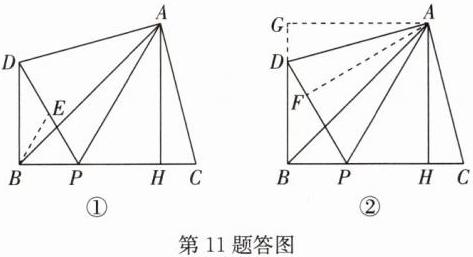
$\therefore BP=PE$,又$∠ BPD=60°$,
$\therefore △ BEP$为等边三角形,
$\therefore ∠ BEP=60°$,$BE=PE=DE$,
$\therefore △ BDE$为等腰三角形,$∠ BEP$是$△ BDE$的外角,
$\therefore ∠ BDE=\frac{1}{2}∠ BEP=30°$,
$\therefore ∠ DBP=180°-60°-30°=90°$,即$BD⊥ BC$。
又$\because AH⊥ BC$,
$\therefore BD// AH$(垂直于同一条直线的两条直线互相平行)。
(3) 证明:如答图②,过点$A$作$AG⊥ BD$,交$BD$的延长线于点$G$,作$AF⊥ DP$于点$F$。
$\because ∠ APC=∠ APD$,即$PA$平分$∠ DPC$,$AH⊥ BC$,$AF⊥ DP$,
根据角平分线的性质,角平分线上的点到角两边的距离相等,$\therefore AH=AF$。
$\because ∠ CBD=90°$,$∠ ABC=45°$,
$\therefore ∠ GBA=∠ CBA=45°$,即$BA$平分$∠ GBC$,
又$AG⊥ BG$,$AH⊥ BC$,$\therefore AG=AH$,
$\therefore AG=AF$,
根据角平分线的判定定理,到角两边距离相等的点在角的平分线上,$\therefore$点$A$在$∠ GDP$的平分线上。
$\because ∠ BDP=30°$,$\therefore ∠ GDP=180°-30°=150°$,
$\therefore ∠ ADP=\frac{1}{2}∠ GDP=75°$,
由轴对称性质得$∠ C=∠ ADP=75°$,
在$\mathrm{Rt}△ ACH$中,$∠ CAH+∠ C=90°$,
$\therefore ∠ CAH=90°-75°=15°$,
又$\because ∠ BAP=15°$,
$\therefore ∠ BAP=∠ CAH$。
【答案】
11.(1)解:$\because ∠ PAB=15°,∠ ABC=45°,$
$\therefore ∠ APC=15°+45°=60°.$
$\because$点$C$关于直线$PA$的对称点为$D$,
$\therefore PD=PC,AD=AC,∠ APC=∠ APD=60°,$
$\therefore ∠ BPD=180°-60°-60°=60°.$
(2)解:直线$BD,AH$平行.理由:$\because BC=3BP,$
$\therefore BP=\frac{1}{2}PC=\frac{1}{2}PD.$
如答图①,取$PD$的中点$E$,连接$BE$,则$BP=PE.$
$\because ∠ BPD=60°,\therefore △ BEP$为等边三角形,$△ BDE$为等腰三角形,
$\therefore ∠ BEP=60°,BE=PE=DE,$
$\therefore ∠ BDE=\frac{1}{2}∠ BEP=30°,$
$\therefore ∠ DBP=90°,$即$BD\bot BC.$
又$\because AH\bot BC,\therefore BD// AH.$
(3)证明:如答图②,过点$A$作$AG\bot BD$,交$BD$的延长线于点$G$,作$AF\bot DP$于点$F$.
$\because ∠ APC=∠ APD$,即点$A$在$∠ DPC$的平分线上,
$\therefore AH=AF.$
$\because ∠ CBD=90°,∠ ABC=45°,$
$\therefore ∠ GBA=∠ CBA=45°,$
即点$A$在$∠ GBC$的平分线上,$\therefore AG=AH,$
$\therefore AG=AF,$
$\therefore$点$A$在$∠ GDP$的平分线上.
又$\because ∠ BDP=30°,$
$\therefore ∠ GDP=150°,\therefore ∠ ADP=\frac{1}{2}×150°=75°,$
$\therefore ∠ C=∠ ADP=75°,$
$\therefore$在$\mathrm{Rt}△ ACH$中,$∠ CAH=15°,$
$\therefore ∠ BAP=∠ CAH.$
【知识点】
轴对称的性质,等边三角形判定与性质,角平分线的性质与判定
【点评】
本题是几何综合题,融合了三角形外角性质、平行线判定、角平分线相关性质等多个考点,需要学生结合已知条件合理构造辅助线,能够有效考察逻辑推理能力和几何知识综合应用能力。
【难度系数】
0.6