16.如图,在一款游戏中,一角色到达一个高为10 m的高台A,利用旗杆顶部的绳索,划过$90°$到达与高台A水平距离为17 m,高为3 m的矮台B,则该角色在荡绳索过程中离地面的最低点的高度$MN=$
2
m.
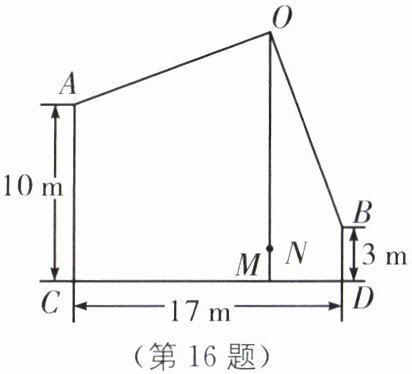
答案:16.2 [解析]如图
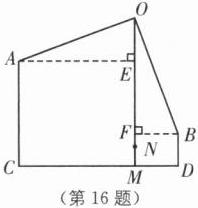
,过点 $A$ 作 $AE⊥ OM$ 于点 $E$,过点 $B$ 作 $BF⊥ OM$ 于点 $F$.
$\because ∠ AOE+∠ BOF=∠ BOF+∠ OBF=90°$,
$\therefore ∠ AOE=∠ OBF$.
在 $△ AOE$ 和 $△ OBF$ 中,$\begin{cases}∠ OEA=∠ BFO,\\∠ AOE=∠ OBF,\\AO=OB,\end{cases}$
$\therefore △ AOE≌△ OBF(\mathrm{AAS})$,$\therefore OE=BF$,$AE=OF$,即 $OE+OF=AE+BF=CD=17\ \mathrm{m}$.
$\because EF=EM-FM=AC-BD=10-3=7(\mathrm{m})$,
$\therefore CD=CM+DM=AE+BF=OF+OE=2OE+EF$,
$\therefore 2OE+EF=17$,$\therefore 2OE=10$,$\therefore OE=5\ \mathrm{m}$,
$\therefore OF=12\ \mathrm{m}$,$\therefore OM=OF+FM=15\ \mathrm{m}$.
又由勾股定理,得 $ON=OB=\sqrt{OF^2+BF^2}=13\ \mathrm{m}$,
$\therefore MN=15-13=2(\mathrm{m})$. 故该角色在荡绳索过程中离地面的最低点的高度 $MN$ 为 2 m.
归纳总结 本题主要考查了勾股定理的应用以及全等三角形的应用,正确得出 $△ AOE≌△ OBF$ 是解题关键.