B 核心素养 思维品质
① Sometimes a little self-criticism(自我批评) is not a bad thing. We all can learn much from our mistakes. However, too much of it may influence your brain and your life. Negative(消极的) self-talk is that little voice in your head. It says you are not good enough. It reminds you of all your faults and mistakes.
② Dr Steven, an educator and researcher on how the mind controls behaviour, said that some good students who study hard normally do not do well in a test because of "test anxiety(考试焦虑)".
③ Lindsay was one of Steven's best students at a community college. She came to class early, took part in discussions and did all of her homework. However, she did poorly in exams. When Steven asked her how she felt before a test, she told him she was very nervous. She wondered why she had trouble remembering what she had studied. She did not trust that she knew the right answers. This is an example of negative self-talk, which can influence a student's grades.
④ Dr Steven took Lindsay's negative self-talk and turned
it into positive(积极的) questions. Before a test, he told Lindsay to say to herself: Why am I so relaxed when I take an exam? Why do I remember everything I study for an exam? Why do I trust my answers?
⑤ Lindsay took his advice. Two weeks later she took an exam in another class and scored 15 points higher than she had on an earlier exam. Four weeks later, she earned an A on the final exam in Steven's class. Lindsay left community college and went to a four-year university. She continued to use the method of positive self-talk. When Dr Steven visited her a year later, she had good news to share: she had got straight As on all of her exams.
⑥ Dr Steven saw student after student succeed with his method. More importantly, they got their self-confidence back. And he does not just help his students. He also encourages his friends and neighbours to get rid of negative self-talk gradually in their life. In a television interview, he said, "We can programme ourselves for success in class or in life, or we can programme ourselves for failure."
(
)29. What's the purpose of Paragraph 3?
A. To introduce Lindsay.
B. To catch readers' interest.
C. To support Dr Steven's idea.
D. To connect the next paragraph.
(
)30.(创新考法·代词指代)What does the underlined word "it" in Paragraph 4 refer to?
A. Lindsay's negative self-talk.
B. Lindsay's difficult test.
C. Lindsay's poor grade.
D. Lindsay's right answer.
(
)31. What's the structure of the passage?
A.
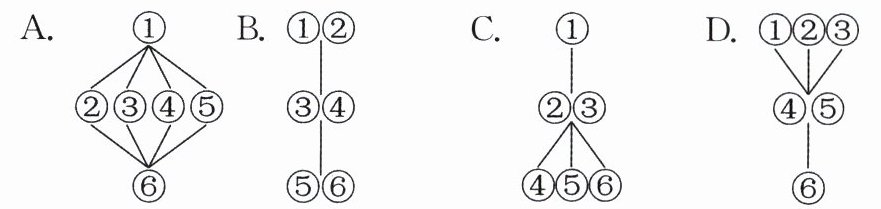
B. ①②
③④
⑤⑥
C. ①
②③
④⑤⑥
D. ①②③
④⑤
⑥
(
)32. What's the best title for the passage?
A. Negative Self-talk Makes You Succeed
B. Negative Self-talk Makes You Better
C. Positive Self-talk Makes a Great Difference
D. Positive Self-talk Can Change Your Goal