五、新趋势 传统文化 选词填空,补全短文。
Wang Yangming was a famous philosopher(哲学家). Here is a story about his father, Wang Hua. When he was six years old, he liked playing with his friends
by
(at/by) the river. One day, a drunken(醉的) man
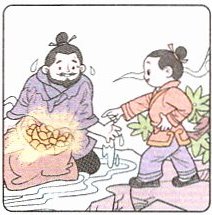
came to the river to
wash
(wash/watch) his feet. He went away in a hurry, but he left a bag on the riverside.
Wang Hua found the bag and
opened
(lost/opened) it. He was surprised! There were many kilos of gold in the bag.
Wang Hua thought this drunken man would come back and
look for
(look for/find) the gold. He was also afraid that someone would see the bag.
So
(Because/So) he put the bag in the river, and waited for the drunken man. After a while, the drunken man came back. He was really sad and
worried
(happy/worried). Wang Hua asked him, “Did you lose a lot of gold?” “Yes!” He answered. Then, Wang Hua took out the bag from the
water
(water/tree) and gave it to the man. The man was very happy to find the lost gold. He wanted to thank Wang Hua and gave one piece of gold to him,
but
(but/or) Wang Hua refused(拒绝) and said, “I didn’t want your bag of gold. Why would I want a piece now?” He
became
(became/were) a good official when he grew up. He
always
(never/always) taught his son to be kind and righteous(正直的).
解析:
【分析】
本题是结合传统文化(王阳明父亲的故事)的选词填空题,需先通读全文理解故事大意,再结合每个空格的前后语境,对括号内的两个选项进行词义、搭配或逻辑关系的辨析,选出最符合语境的单词。
【解析】
1. 第一空:“by the river”是固定搭配,意为“在河边”,“at the river”不符合表达习惯,故选by。
2. 第二空:根据语境,醉汉到河边是“洗”脚,“wash”表示洗,“watch”表示观看,故选wash。
3. 第三空:王华发现袋子后“打开”它,“opened”表示打开,“lost”表示丢失,故选opened。
4. 第四空:醉汉回来是“寻找”金子(强调寻找的动作),“look for”符合,“find”强调找到的结果,故选look for。
5. 第五空:前文提到王华怕别人看到袋子,“因此”把袋子放河里等醉汉,“So”表结果,“Because”表原因,故选So。
6. 第六空:醉汉找不到金子,心情是“担心的”,“worried”符合,“happy”不符合语境,故选worried。
7. 第七空:袋子放在河里,所以从“水”里拿出,“water”符合,“tree”不符合,故选water。
8. 第八空:醉汉要给金子,王华拒绝,是转折关系,“but”表转折,“or”表选择,故选but。
9. 第九空:主语是he,过去式表示“成为好官员”,用“became”,“were”不匹配主语,故选became。
10. 第十空:他“总是”教儿子善良正直,“always”符合,“never”不符合语境,故选always。
【答案】by, wash, opened, look for, So, worried, water, but, became, always
【知识点】介词辨析、动词辨析、连词用法
【点评】本题结合传统文化故事,考查词汇在语境中的运用,需学生掌握短语搭配和词义辨析,难度适中,能帮助学生积累传统文化相关的英语表达。
【难度系数】0.5