四、核心素养语言能力 任务型阅读。
阅读下面短文,根据所读内容,在文章后题的空格里填入最恰当的内容。注意:1~8题每个空格只填1个单词,第9题词数不少于20。
主题群:文学、艺术与体育 子主题:电影艺术 语篇类型:说明文 难度:★★★
In China, unlike in many other countries, movies almost always have subtitles(字幕) in both Chinese and English. This common practice has several key purposes: to improve understanding, increase accessibility(易于理解和使用), and support cultural exchange.
First, China has many dialects(方言). People in different parts of China speak differently. Besides Mandarin, there are many other local dialects. Some movie characters speak in these dialects to make the story feel real. It presents a challenge to the understanding of viewers from other areas. Subtitles help everyone in China follow the story, no matter what dialect they speak.
Second, some actors have soft or deep voices. These voices can sound emotional but are sometimes hard to hear in a loud cinema, especially with powerful bass sound. Subtitles make sure viewers don't miss any words.
Third, cinema sound is fixed. You can turn your TV up or down, but you cannot control the volume in a cinema. Sometimes, the background music or sound effects are too loud compared to the actors' voices. The sound might not be perfect, but subtitles help viewers follow the story easily.
Moreover, subtitles make films more inclusive(包容性). They help deaf or hard-of-hearing viewers understand the dialogue, giving them a full and enjoyable experience.
Finally, English subtitles help Chinese movies go around the world. English is the world's most popular second language. With English subtitles, international viewers, film festival judges, and movie critics can watch and understand Chinese films. This builds cross-cultural understanding and allows these films to be judged fairly on an international stage.
In short, subtitles do more than just translate words—they build a bridge between cultures. They turn every film into a place where people from all over the world can meet and share stories.
| Introduction | Chinese and English subtitles help people 1.
understand
, access, and share culture. |
| --- | --- |
| 2.
Reasons
for Chinese and English subtitles | When actors use local dialects, it is 3.
difficult
for viewers from other areas to understand. Subtitles help everyone follow the story in any dialect. |
| | Subtitles help viewers understand every word. |
| | Cinema sound is 4.
beyond
the audience's control. |
| | Subtitles make sure you will follow the story 5.
although/though
the sound isn't perfect. |
| | Subtitles help people who have 6.
trouble/difficulty
hearing the dialogue. |
| | They help deaf or hard-of-hearing
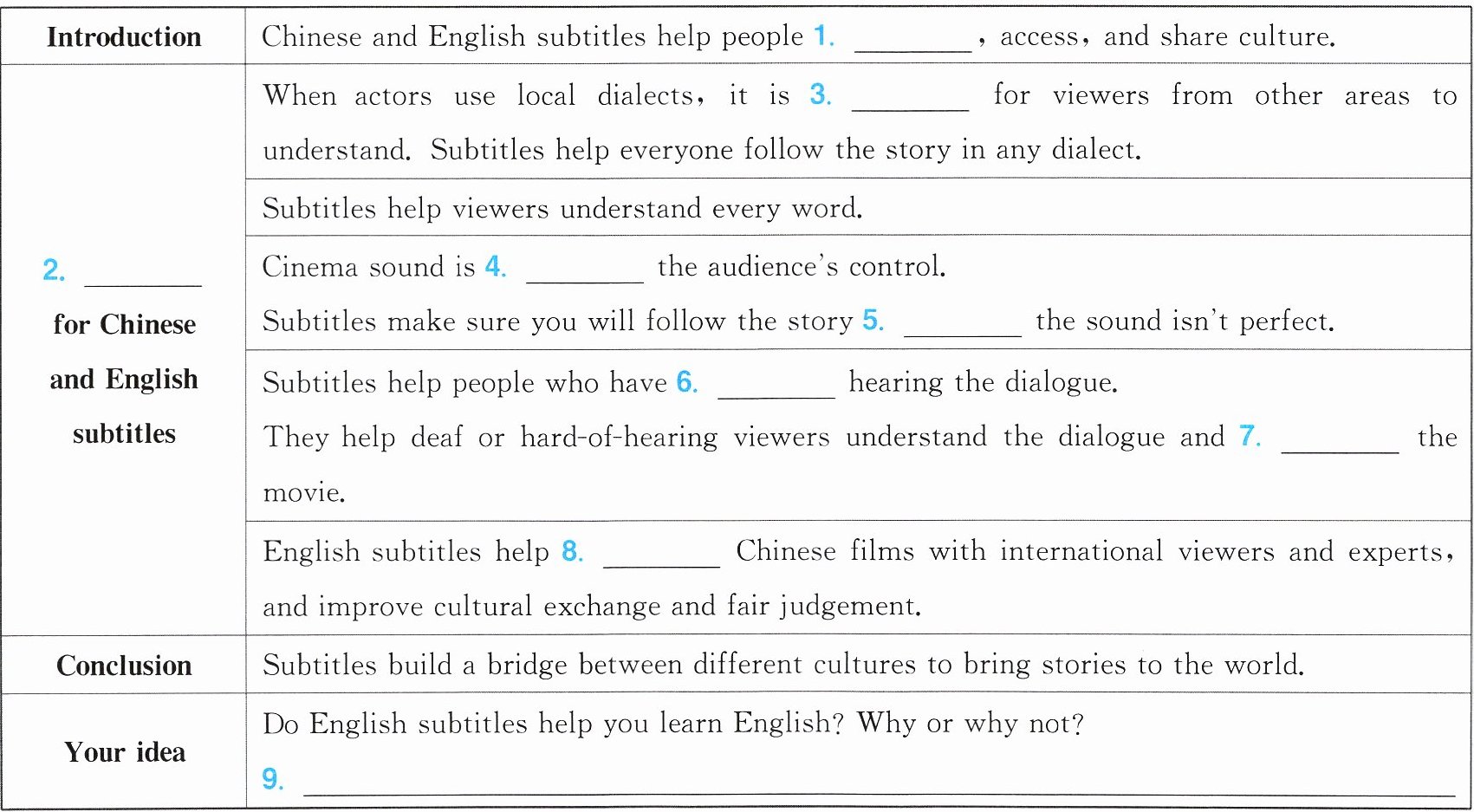
viewers understand the dialogue and 7.
enjoy
the movie. |
| | English subtitles help 8.
connect
Chinese films with international viewers and experts, and improve cultural exchange and fair judgement. |
| Conclusion | Subtitles build a bridge between different cultures to bring stories to the world. |
| Your idea | Do English subtitles help you learn English? Why or why not? 9.
Yes, they do. English subtitles help me catch words I miss by ear and learn new expressions in real contexts.
|