【分析】
(1) 要证∠BED=∠AFD,可先利用四边形内角和与已知的两个直角,推出∠AFD与∠AED互补,再结合∠BED与∠AED互为邻补角,利用同角的补角相等即可得证。
(2) 要证BE²+CF²=EF²,符合勾股定理的结构特征,需将三条线段转移到同一个直角三角形中。可通过倍长ED构造全等三角形,把BE转化为CP,再证EF=FP,最后证明∠FCP为直角,结合勾股定理即可推导结论。
(3) 当∠ABC=45°时,△ABC为等腰直角三角形,结合D是BC中点的性质,可证△AED≌△CFD,得到DE=DF,即△DEF是等腰直角三角形,再利用(2)的结论求出EF²,结合等腰直角三角形的面积公式即可求解。
【解析】
(1) 证明:$\because DE⊥ DF$,$\therefore ∠EDF=90°$.
$\because ∠BAC=90°$,四边形AEDF内角和为$360°$,$\therefore ∠AFD+∠AED=360°-90°-90°=180°$.
$\because ∠BED+∠AED=180°$,$\therefore ∠BED=∠AFD$.
(2) 证明:如答图①,延长ED到点P,使$DP=DE$,连接FP,CP.
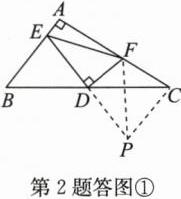
第2题答图①
$\because D$是BC的中点,$\therefore BD=CD$.
在$△ BED$和$△ CPD$中,$\begin{cases} ED=PD, \\ ∠EDB=∠PDC, \\ BD=CD, \end{cases}$
$\therefore △ BED≌△ CPD(\mathrm{SAS})$,$\therefore BE=CP$,$∠B=∠PCD$.
在$△ EDF$和$△ PDF$中,$\begin{cases} DE=DP, \\ ∠EDF=∠PDF=90°, \\ DF=DF, \end{cases}$
$\therefore △ EDF≌△ PDF(\mathrm{SAS})$,$\therefore EF=FP$.
$\because ∠BAC=90°$,$\therefore ∠B+∠ACB=90°$,$\therefore ∠ACB+∠DCP=90°$,即$∠FCP=90°$.
在$\mathrm{Rt}△ FCP$中,根据勾股定理,得$CF^2+CP^2=PF^2$,
$\because BE=CP$,$PF=EF$,$\therefore BE^2+CF^2=EF^2$.
(3) 解:如答图②,连接AD,过点D作$DG⊥ EF$于点G.
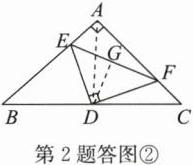
第2题答图②
由题意知$△ ABC$为等腰直角三角形.
$\because D$为BC边的中点,$\therefore ∠BAD=∠FCD=45°$,$AD=BD=CD$,$AD⊥ BC$,$\therefore ∠ADF+∠FDC=90°$.
$\because DE⊥ DF$,$\therefore ∠EDA+∠ADF=90°$,$\therefore ∠EDA=∠FDC$.
在$△ AED$和$△ CFD$中,$\begin{cases} ∠EAD=∠FCD, \\ AD=CD, \\ ∠ADE=∠CDF, \end{cases}$
$\therefore △ AED≌△ CFD(\mathrm{ASA})$,
$\therefore AE=CF=5$,$DE=DF$,$\therefore △ EDF$为等腰直角三角形,
$\therefore ∠DEF=∠DFE=∠EDG=∠FDG=45°$,
$\therefore DG=EG=FG$,$\therefore DG=\dfrac{1}{2}EF$.
由(2)知$EF^2=BE^2+CF^2=12^2+5^2=144+25=169$,
$\therefore S_{△ DEF}=\dfrac{1}{2}EF· DG=\dfrac{1}{2}EF· \dfrac{1}{2}EF=\dfrac{1}{4}EF^2=\dfrac{169}{4}$.
【答案】
(1) 证明见上述解析;
(2) 证明见上述解析,对应辅助线图:
;
(3) $△ DEF$的面积为$\dfrac{169}{4}$,对应辅助线图:
。
【知识点】
全等三角形判定与性质,勾股定理,等腰直角三角形性质
【点评】
本题是几何综合题,核心是通过构造全等三角形实现线段的转化,既考查了基础的角相等证明,又涉及勾股定理的应用和特殊三角形的面积计算,解题时要注意前后小问的关联性,前一问的结论可直接为后一问所用,熟练掌握辅助线的构造技巧是解题的关键。
【难度系数】
0.6