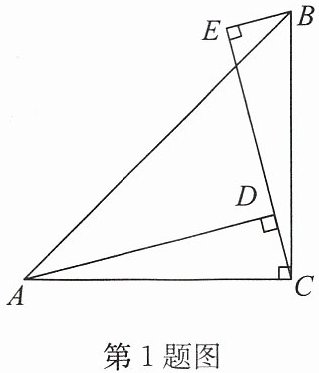
1. 如图,$∠ ACB=90°$,$AC=BC$,$AD⊥ CE$,$BE⊥ CE$,垂足分别是$D$,$E$,$AD=3$,$BE=1$,则$△ ABC$的面积是 (
B
)
A.$\frac{3}{2}$
B.$5$
C.$2\sqrt{2}$
D.$\sqrt{10}$
答案:1.B 点拨:$\because AD⊥ CE,BE⊥ CE,\therefore ∠ ADC=∠ E=90°,$
$\therefore ∠ DAC+∠ ACD=90°.$
$\because ∠ ACB=90°,\therefore ∠ ACD+∠ ECB=90°,\therefore ∠ DAC=∠ ECB.$ 在$△ ACD$和$△ CBE$中,$\begin{cases} ∠ DAC=∠ ECB, \\ ∠ ADC=∠ E, \\ AC=CB, \end{cases}$
$\therefore △ ACD≌△ CBE(\mathrm{AAS}),$
$\therefore CD=BE=1.$ 在$\mathrm{Rt}△ ACD$中,$AD=3,CD=1,$由勾股定理,得$AC=\sqrt{AD^2+CD^2}=\sqrt{3^2+1^2}=\sqrt{10},$
$\therefore AC=BC=\sqrt{10}.$
$\because ∠ ACB=90°,\therefore △ ABC$是等腰直角三角形,
$\therefore S_{△ ABC}=\frac{1}{2}AC· BC=\frac{1}{2}×\sqrt{10}×\sqrt{10}=5.$
解析:
【分析】
首先观察图形和已知条件,图中存在多个直角,且有一组相等的边AC=BC,属于典型的“一线三垂直”全等模型。解题思路如下:第一步,利用直角三角形两锐角互余,结合∠ACB=90°,推导得出∠DAC=∠ECB;第二步,根据AAS证明△ACD和△CBE全等,得到CD=BE=1;第三步,在Rt△ACD中用勾股定理求出AC的长度;第四步,因为△ABC是等腰直角三角形,代入面积公式计算即可得到结果。
【解析】
解:$\because AD⊥ CE,BE⊥ CE,\therefore ∠ ADC=∠ E=90°,$
$\therefore ∠ DAC+∠ ACD=90°.$
$\because ∠ ACB=90°,\therefore ∠ ACD+∠ ECB=90°,\therefore ∠ DAC=∠ ECB.$
在$△ ACD$和$△ CBE$中:
$\begin{cases} ∠ DAC=∠ ECB \\ ∠ ADC=∠ E \\ AC=CB \end{cases}$
$\therefore △ ACD≌△ CBE(\mathrm{AAS}),$
$\therefore CD=BE=1.$
在$\mathrm{Rt}△ ACD$中,$AD=3,CD=1$,由勾股定理得:
$AC=\sqrt{AD^2+CD^2}=\sqrt{3^2+1^2}=\sqrt{10},$
$\therefore AC=BC=\sqrt{10}.$
$\because ∠ ACB=90°,$
$\therefore S_{△ ABC}=\frac{1}{2}AC· BC=\frac{1}{2}×\sqrt{10}×\sqrt{10}=5.$
【答案】
B
【知识点】
全等三角形的判定与性质;勾股定理;等腰直角三角形面积计算
【点评】
本题是“一线三垂直”全等模型的典型应用,解题的关键是利用同角的余角相等得到相等的对应角,进而证明三角形全等,再结合勾股定理求出直角边长度即可计算面积,解题时要注意几何推导逻辑的严谨性。
【难度系数】
0.7
2.(1)如图①,在$△ ABC$中,$∠ ACB=90°$,$CA=CB$,过点$C$的直线$l$经过三角形内部,过点$A$作$AD⊥ l$于点$D$,过点$B$作$BE⊥ l$于点$E$,则$BE$与$AD$,$DE$的数量关系为
BE=AD+DE
,请证明你所写的结论;
(2)尝试探究:若$BE=a$,$AD=b$.
①如图①,连接$AE$,$BD$,四边形$ADBE$的面积为
$\frac{1}{2}a^2-\frac{1}{2}b^2$
(用含$a$,$b$的代数式表示);
②如图②,若过点$C$的直线$l$不经过$△ ABC$内部,其他条件不变,则四边形$ADEB$的面积为
$\frac{1}{2}(a+b)^2$
(用含$a$,$b$的代数式表示).
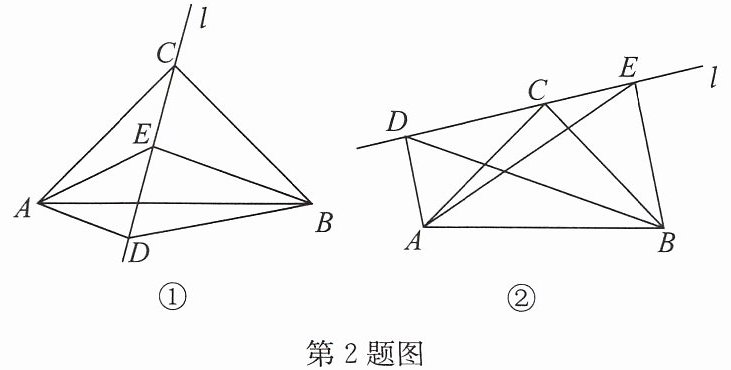
答案:2.(1)解:$BE=AD+DE$. 证明如下:
$\because AD⊥ l,BE⊥ l,\therefore ∠ ADC=∠ CEB=90°,$
$\therefore ∠ ACD+∠ CAD=90°.$
$\because ∠ ACB=90°,\therefore ∠ ACD+∠ BCE=90°,$
$\therefore ∠ CAD=∠ BCE.$
在$△ ADC$和$△ CEB$中,$\begin{cases} ∠ CAD=∠ BCE, \\ ∠ ADC=∠ CEB, \\ CA=BC, \end{cases}$
$\therefore △ ADC≌△ CEB(\mathrm{AAS}),\therefore BE=CD,AD=CE.$
$\because CD=CE+DE,\therefore BE=AD+DE.$
(2)①$\frac{1}{2}a^2-\frac{1}{2}b^2$
点拨:$\because BE=a,AD=b,$
$\therefore$ 根据(1)可知:$DE=BE-AD=a-b,$
$\therefore S_{\mathrm{四边形}ADBE}=S_{△ ADE}+S_{△ BDE}=\frac{1}{2}DE· AD+\frac{1}{2}DE· BE=\frac{1}{2}(a-b)· b+\frac{1}{2}(a-b)· a=\frac{1}{2}(a-b)(a+b)=\frac{1}{2}a^2-\frac{1}{2}b^2.$
②$\frac{1}{2}(a+b)^2$
点拨:根据(1)同理可证$△ ADC≌△ CEB,\therefore AD=CE=b,BE=CD=a,$
$\therefore DE=CD+CE=a+b,\therefore$ 四边形$ADEB$的面积为$\frac{1}{2}(a+b)^2.$
解析:
【分析】
(1) 本题属于“一线三垂直”全等模型类题目,解题时先根据垂直条件得到两组直角相等,再利用同角的余角相等推出一组对应角相等,结合已知的$CA=CB$,用AAS判定$△ ADC$和$△ CEB$全等,得到对应边相等后,结合线段和差关系即可推出$BE$、$AD$、$DE$的数量关系。
(2) ①求四边形$ADBE$的面积时,可将其拆分为$△ ADE$和$△ BDE$的面积之和,利用(1)的结论得到$DE$的长度,代入三角形面积公式化简即可;②同理先证明$△ ADC≌△ CEB$,得到$DE$的长度,再将四边形拆分为两个三角形面积之和,代入计算即可。
【解析】
(1) 结论为$BE=AD+DE$,证明如下:
$\because AD⊥ l,BE⊥ l,\therefore ∠ ADC=∠ CEB=90°$,
$\therefore ∠ ACD+∠ CAD=90°$。
$\because ∠ ACB=90°,\therefore ∠ ACD+∠ BCE=90°$,
$\therefore ∠ CAD=∠ BCE$。
在$△ ADC$和$△ CEB$中,
$\begin{cases}∠ CAD=∠ BCE \\∠ ADC=∠ CEB \\CA=CB\end{cases}$
$\therefore △ ADC≌△ CEB(\mathrm{AAS})$,$\therefore BE=CD,AD=CE$。
$\because CD=CE+DE$,$\therefore BE=AD+DE$。
(2) ①$\because BE=a,AD=b$,由(1)的结论可得$DE=BE-AD=a-b$,
四边形$ADBE$的面积为:
$S_{\mathrm{四边形}ADBE}=S_{△ ADE}+S_{△ BDE}=\frac{1}{2}DE· AD+\frac{1}{2}DE· BE$
$=\frac{1}{2}(a-b)· b+\frac{1}{2}(a-b)· a=\frac{1}{2}(a-b)(a+b)=\frac{1}{2}a^2-\frac{1}{2}b^2$。
②同理可证$△ ADC≌△ CEB$,$\therefore AD=CE=b,BE=CD=a$,
$\therefore DE=CD+CE=a+b$,
四边形$ADEB$的面积为:
$S_{\mathrm{四边形}ADEB}=S_{△ ADE}+S_{△ BDE}=\frac{1}{2}DE· AD+\frac{1}{2}DE· BE$
$=\frac{1}{2}(a+b)· b+\frac{1}{2}(a+b)· a=\frac{1}{2}(a+b)^2$。
【答案】
(1) $BE=AD+DE$
(2) ①$\frac{1}{2}a^2-\frac{1}{2}b^2$;②$\frac{1}{2}(a+b)^2$
【知识点】
一线三垂直模型、全等三角形判定与性质、图形面积计算
【点评】
本题是“一线三垂直”全等模型的典型应用,解题核心是利用同角的余角相等推导对应角相等,证明三角形全等后通过线段转化求解数量关系或面积,熟练掌握该模型可快速解决同类型几何问题。
【难度系数】
0.65