五、阅读理解。
新素养 文化认同 ① Foreigners like growing flowers in the garden and enjoy the nice smell in spring. However, Chinese people prefer growing vegetables and get a harvest(收获) in autumn. For Chinese, bottles, even plastic bags are perfect for growing vegetables.
② It's said that there is a “vegetable gene(基因)” in every Chinese person. After all, they have farmed for thousands of years and gained rich experience in growing vegetables.
③ A group of parents of Chinese students once grew vegetables at Yale University in the USA. This area used to be covered with weeds(杂草). To help change the situation, these Chinese parents worked together and finally turned weeds into vegetables.
④ Africa is such a poor place. Many hard-working and kind-hearted Chinese workers went there to help. They helped build roads as well as teach Africans how to farm. All kinds of fruit and vegetables have been grown in Africa.
⑤ The soldiers(士兵) on the islands of the South China Sea also created a vegetable garden through their own efforts(努力). It used to be difficult for the soldiers to eat fresh vegetables on the islands. But recently, they harvested 750 kg of vegetables on sandy beaches. Everyone was excited.
⑥ With the development of science and technology in China, Chinese people have grown vegetables all over the world, from Europe to Africa. The days of planting potatoes on Mars(火星) will not be far away.
1. How does the writer start the passage?
A. By listing some numbers.
B. By asking some questions.
C. By telling different jokes(玩笑).
D. By comparing different facts.
2. Which of the following is NOT the fact to show Chinese people's “vegetable gene”?
A. Chinese people have much farming experience for planting.
B. Chinese people have already planted potatoes in outer space, such as on Mars.
C. Chinese soldiers on the islands of the South China Sea harvested 750 kg of vegetables.
D. Parents of Chinese students at Yale University turned weeds into vegetables.
3. 新考法 篇章结构 Which of the following best shows the structure of the passage?
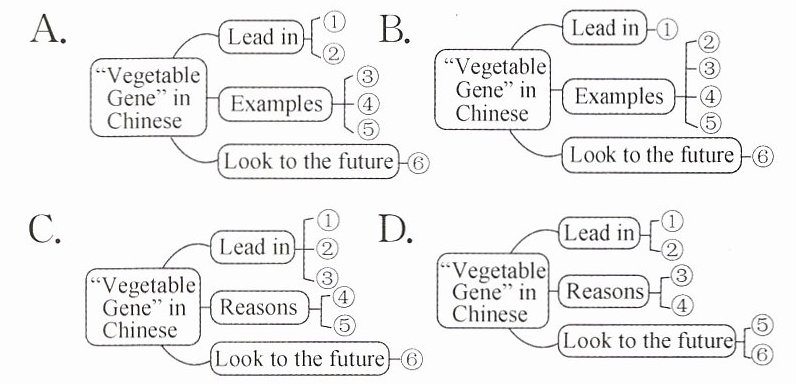
4. 新考法 情感基调 What tone(语气) does the writer use in this passage?
A. Polite.
B. Proud(自豪的).
C. Sad.
D. Bored.