四、对在学校开设种植课程这一措施,不同的人有不同的意见,看看同学们都持什么观点吧!
Some people say growing food is good for the mind and body.
What you need to know
• Food growing has been taught in schools for more than 100 years in the UK.
• At most schools, food growing is an extracurricular(课外的)activity. This means it's usually an after-class club instead of a lesson like English or Maths.
• The number of school students in the UK growing their own food has grown since 2023, according to a recent survey.
Some people say that growing food is a skill that every child should learn while others think it's not necessary. What do you think? Should children learn to grow food?
Yes—it teaches children so much. Growing food is a fun way to learn about lots of things besides books. Students get to know where food usually comes from and it's a way to learn more about soil, insects and the weather. Also, if children grow food, studies show that it helps them to be healthier. Planting, watering and moving around outside are great ways to keep fit just like PE. Besides, watching a small seed grow into food makes students feel like they get something besides the stressful numbers on the test papers.
No—it's not a necessary skill. Not all schools have enough space to grow food. Buying seeds and gardening tools also cost money. Some schools may be troubled in finding the right place and sparing enough money. Besides, looking after a patch(小块土地) properly takes time and effort—perhaps more than students can give. Schools would have to get help from staff or volunteers to manage the weeding(除草), watering and so on. Anyway, most students will buy their food from shops in the future. Growing food is a lovely hobby but it's not a necessary life skill.
Should students learn to grow food?
Three
facts
about food growing lessons in the UK
• They have a
history
of over 100 years in the UK.
• Usually they are not lessons like English or Maths, but
activities
after class.
•
More
students are taking such lessons in the UK than before.
Two
ideas/opinions
about food growing lessons for students
• They help students learn a lot
out
of books in a fun way.
• They can be
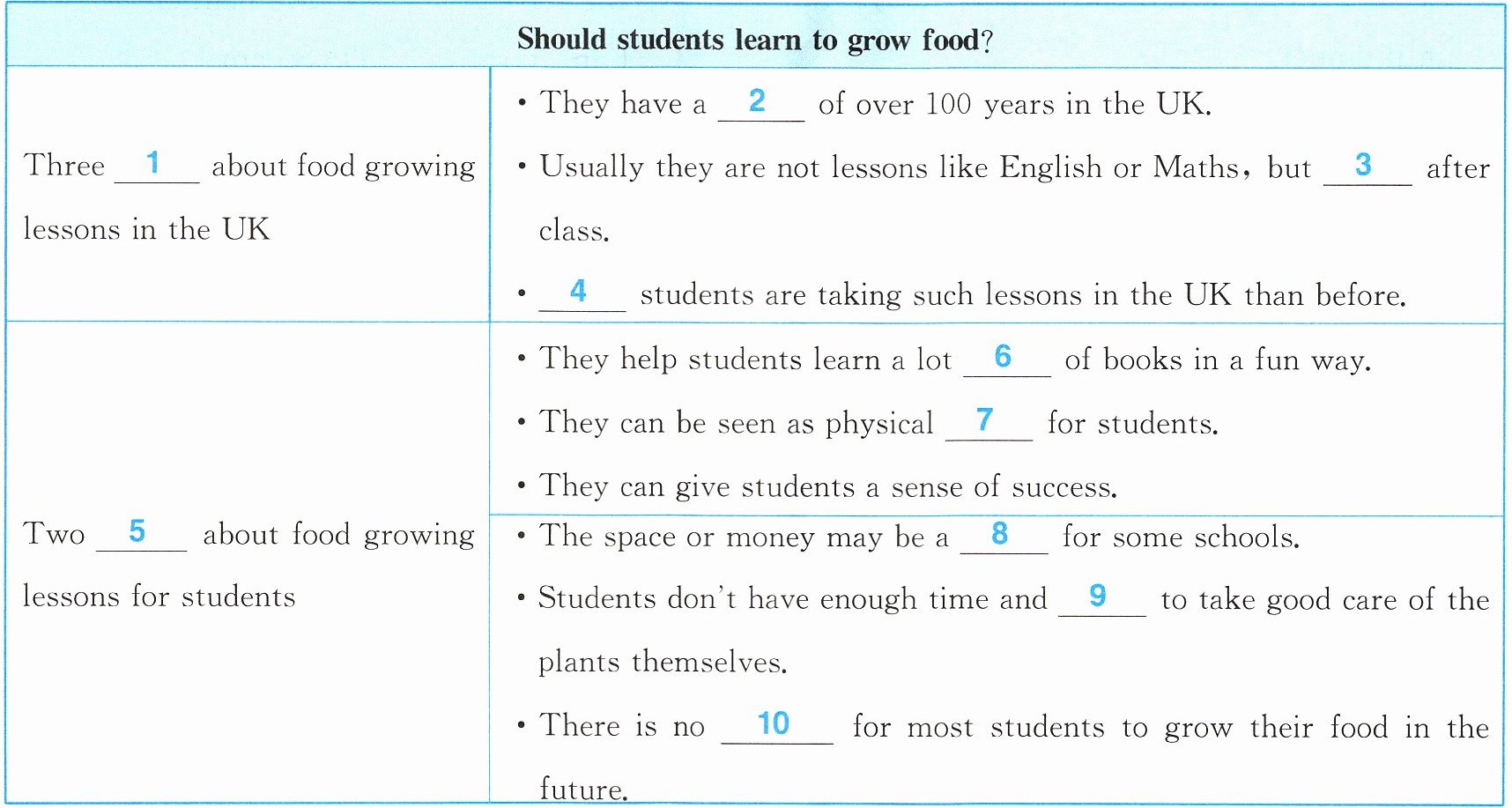
as physical
exercise
for students.
• They can give students a sense of success.
• The space or money may be a
trouble
for some schools.
• Students don't have enough time and
energy
to take good care of the plants themselves.
• There is no
need
for most students to grow their food in the future.
1.
facts
2.
history
3.
activities
4.
More
5.
ideas/opinions
6.
out
7.
exercise
8.
trouble
9.
energy
10.
need