零五网 全部参考答案 同步练习答案 2026年同步练习江苏六年级英语上册译林版 第37页解析答案
一、根据所听内容完成表格,每空一词,听两遍。
Person Birthday My gift
My friend Bob 1.
23rd
January A pencil case
My friend Susan 5th 2.
April
A 3.
storybook

My sister Amy 12th 4.
July
A toy bear
My cousin Andy 5.
22nd
August A toy car
答案:1. 23rd 2. April 3. storybook 4. July 5. 22nd
二、根据图片提示补全句子,每空一词。
1. Yesterday was
21st
October. It was my
10th/tenth
birthday. My family sang the song “Happy Birthday” for me. Then I made a wish and
blew
out the candles.
2. On Chinese New Year’s Eve, we always put up paper-cuttings on the
windows
. Chinese New Year’s Eve is on the last day of the lunar year, usually on the 29th or
30th
of the
twelfth
lunar month.
答案:1. 21st, 10th/tenth, blew 2. windows, 30th, twelfth
解析:
【分析】
解题时需结合句子语境、固定短语及节日常识填空。第1题:第一空需填十月的日期,结合生日语境;第二空修饰birthday,用序数词表“第几个生日”;第三空对应“吹蜡烛”的固定短语,需用过去式。第2题:第一空是贴剪纸的场所;第二空是农历年最后一天的日期;第三空是农历月份的序数词(第十二个)。
【解析】
1. 第一空:根据生日语境,填日期序数词21st;第二空:修饰birthday,用序数词10th/tenth;第三空:固定短语blow out(吹灭),过去式为blew。
2. 第一空:春节贴剪纸在窗户,填windows;第二空:农历年最后一天是29或30,填30th;第三空:农历第十二个月,填twelfth。
【答案】
1. 21st, 10th/tenth, blew 2. windows, 30th, twelfth
【知识点】
序数词的用法、固定短语搭配、节日文化常识
【点评】
本题结合日常与节日语境,考察基础词汇、序数词及固定表达,难度适中,需学生结合语境和常识作答。
【难度系数】
0.5
三、阅读短文,选择正确的选项。
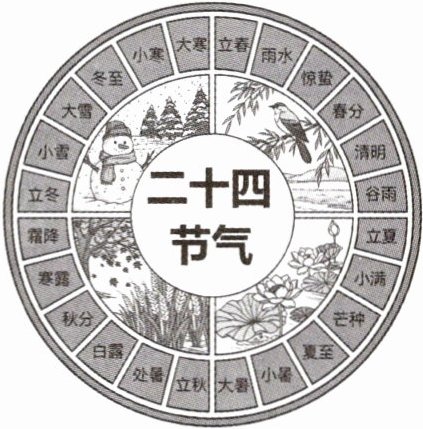
The Twenty-four Solar Terms is an important part of traditional Chinese culture. It is based on the sun's movement. It divides (分成) a year into 24 different parts. Each solar term lasts about 15 days. People use them to learn about changes in weather and seasons. They also use them to decide the right time for farming.
Start of Spring usually comes on 3rd or 4th February. It marks the beginning of spring. Summer Solstice (夏至) falls on 21st or 22nd June every year. It has the longest daytime of the whole year. White Dew (白露) arrives on 7th or 8th September. It tells people that cool autumn is on the way. Winter Solstice (冬至) is on 21st or 22nd December. On this day, we have the shortest daytime in a year.
In 2016, the Twenty-four Solar Terms was listed as an Intangible Heritage of Humanity (人类非物质文化遗产) by UNESCO. Even today, people still follow these special dates to arrange (安排) their lives and farming activities. The solar terms fully show the great wisdom (智慧)
of ancient Chinese people. We should protect and pass on this wonderful traditional culture.
(
D
) 1. How many solar terms are there in a year?
A. Twelve. B. Fifteen. C. Twenty. D. Twenty-four.
(
B
) 2. How long does each solar term last?
A. About 10 days. B. About 15 days.
C. About 20 days. D. About 25 days.
(
D
) 3. When is Winter Solstice?
A. On 21st or 22nd June. B. On 7th or 8th September.
C. On 4th February. D. On 21st or 22nd December.
(
A
) 4. Which sentence is true according to the passage?
A. White Dew tells us cool autumn is coming.
B. Summer Solstice has the shortest daytime in a year.
C. The Twenty-four Solar Terms became an Intangible Heritage of Humanity in 2018.
D. The Twenty-four Solar Terms is not useful (有用的) for people now.
(
C
) 5. What is the main idea of the passage?
A. The different seasons in China.
B. The famous festivals around the world.
C. The Twenty-four Solar Terms.
D. The history of UNESCO.

答案:1. D 2. B 3. D 4. A 5. C
解析:
【分析】
本题为阅读理解题,需结合短文内容逐一分析每个问题:
1. 第1题询问一年的节气数量,需定位原文中关于节气数量的描述;
2. 第2题询问每个节气的时长,需查找原文中关于时长的信息;
3. 第3题询问冬至的时间,需定位冬至对应的日期内容;
4. 第4题需判断四个选项中符合原文的句子,需逐一核对选项与原文细节;
5. 第5题需概括短文主旨,需梳理全文围绕的核心话题。
【解析】
1. 原文第一段提到“The Twenty-four Solar Terms... divides a year into 24 different parts.”,可知一年有24个节气,对应选项D;
2. 原文第一段明确说明“Each solar term lasts about 15 days.”,对应选项B;
3. 原文第二段指出“Winter Solstice (冬至) is on 21st or 22nd December.”,对应选项D;
4. 逐一核对选项:A选项对应原文第二段“White Dew... tells people that cool autumn is on the way.”,正确;B选项夏至是一年中最长白天,错误;C选项2016年二十四节气被列入人类非物质文化遗产,错误;D选项至今人们仍用节气安排生活和农事,错误,故选A;
5. 全文围绕“二十四节气”展开,介绍其定义、特点、意义等,主旨为二十四节气,对应选项C。
【答案】
1.D 2.B 3.D 4.A 5.C
【知识点】
阅读理解、细节理解、主旨大意
【点评】
本题考查英语短文的细节查找与主旨概括能力,题目以基础细节题为主,难度适中,能有效检验学生的信息定位和文本理解能力。
【难度系数】
0.7
上一页 下一页