B
In the Tang Dynasty, there were no cars. People went home in a carriage(马车). There were no traffic lights on the road or even traffic rules. There were no computers, either. People couldn't use the internet. They did all the things with their own hands.
But today robots help to do many things. Robots are helpful. People use them in factories to help the workers. These robots are not like the robots in movies. They don't walk or talk. Sometimes, a robot may be just a metal(金属的) arm. It can do the same job in a factory over and over again. Sometimes a robot may be just like Robin. It can help people to send things to the guests(客人) in a hotel or a restaurant. Some robots are useful robots that can answer any questions you ask.
In the future there will be household robots. They will help people do housework. They can even help you when you are ill. But is it good or bad for our life? Do you want to have a robot in the future?
阅读短文,完成下列任务。
任务一:根据短文内容,判断正(T)误(F)。
(
T
) 1. In the Tang Dynasty, people didn't go by car.
(
F
) 2. All the robots can talk and walk like the robots in the movies.
(
T
) 3. A robot can do the same job in a factory over and over again.
(
F
) 4. A robot can't help people to send things to the guests in a hotel or a restaurant.
(
T
) 5. In the future, there will be household robots to help people do housework.
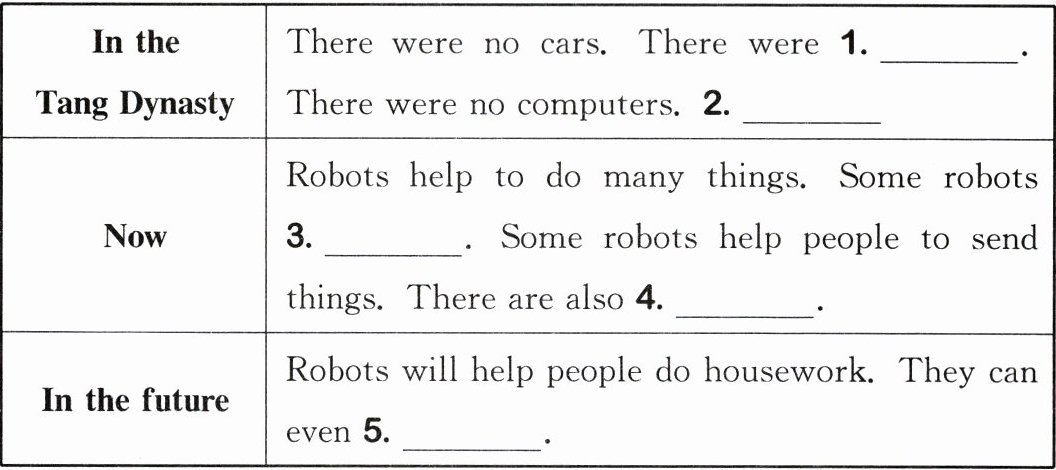
任务二:根据短文内容,选择对应的选项完成表格。
A. People did all the things with their own hands.
B. may be just a metal arm
C. help you when you are ill
D. useful robots that can answer any questions you ask
E. no traffic lights on the road or even traffic rules
解析:
【分析】
本题分为任务一(判断正误)和任务二(表格填空),解题思路均为定位原文对应内容,逐一匹配答案:
1. 任务一:每个判断需回到原文找依据,核对描述是否与原文一致,注意细节(如“all”“not”等限定词)。
2. 任务二:根据表格中时间(唐代/现在/未来)和上下文语境,匹配选项与原文对应语句,确保逻辑通顺。
【解析】
任务一(判断正误)
1. 原文第一段明确“In the Tang Dynasty, there were no cars.”,说明唐代人们不用车,故1为T。
2. 原文第二段提到“These robots are not like the robots in movies. They don't walk or talk.”,并非所有机器人都像电影里一样会走会说,故2为F。
3. 原文第二段明确“It can do the same job in a factory over and over again.”,故3为T。
4. 原文第二段提到“It can help people to send things to the guests in a hotel or a restaurant.”,机器人可以帮忙送东西,故4为F。
5. 原文第三段明确“In the future there will be household robots. They will help people do housework.”,故5为T。
任务二(表格填空)
1. 唐代无汽车,对应原文“There were no cars. There were no traffic lights on the road or even traffic rules.”,选E。
2. 唐代无电脑,对应原文“There were no computers, either. They did all the things with their own hands.”,选A。
3. 现在工厂的机器人,对应原文“Sometimes, a robot may be just a metal arm. It can do the same job in a factory over and over again.”,选B。
4. 现在其他类型的机器人,对应原文“Some robots are useful robots that can answer any questions you ask.”,选D。
5. 未来机器人的额外功能,对应原文“They can even help you when you are ill.”,选C。
【答案】
任务一:1.T 2.F 3.T 4.F 5.T
任务二:1.E 2.A 3.B 4.D 5.C
【知识点】
英语阅读理解、细节理解题、判断正误题
【点评】
本题考查学生对英语阅读原文细节的定位与理解能力,题型常规,需学生仔细核对原文与题干的匹配度,避免因忽略限定词(如“all”“not”)出错,整体难度适中。
【难度系数】
0.6