Ⅱ. 阅读理解
①As humans, we communicate by using the senses of sight, touch, and hearing. We send messages with body language, we greet friends with touch, and we speak by using words to show our feelings and ideas. Animals don't communicate in as many ways as us—for example, they don't have languages like we do—but many animals do also use the senses of sight, touch, and hearing. A good example of this is the communication between elephants.
②Like us, elephants understand each other by looking at each other's body language. To send a message, they use their whole body, or just their head, eyes, mouth, ears, trunk, tail, or feet. For example, elephants spread(展开) their ears to show anger. And while people shake(摇晃) their heads to say no, elephants do this to show they are happy.
③Touch is also very important between elephants. Just like a human mother holds her baby, a mother elephant regularly touches her young baby with her trunk. Elephants also show they are friendly when they touch other elephants. And when they want to have fun, they hold each other by the trunk and pull. Although they can't laugh like a human, elephants have a great sense of humour.
④Elephants have very large ears, which means they can hear other elephants from as far as 2.5 miles away. Like humans, they can also copy sounds and make their own sounds that seem to communicate some human words and phrases like "Hello" "I love you" and "Let's go".
⑤So while it's true that humans are amazing at communication, elephants also communicate in ways that we can't, and that may be true for other animals, too. The next time your pet dog or cat looks at you, touches you, or makes a noise, maybe it's trying to tell you something very important!
1. How do elephants show they are happy?
A. By using their whole body.
B. By spreading their ears.
C. By shaking their heads.
D. By touching other elephants.
2. According to the passage, what can elephants do?
A. They can copy sounds they hear.
B. They can speak with words.
C. They can laugh like a human.
D. They can have languages.
3. Which is the best structure of the passage?
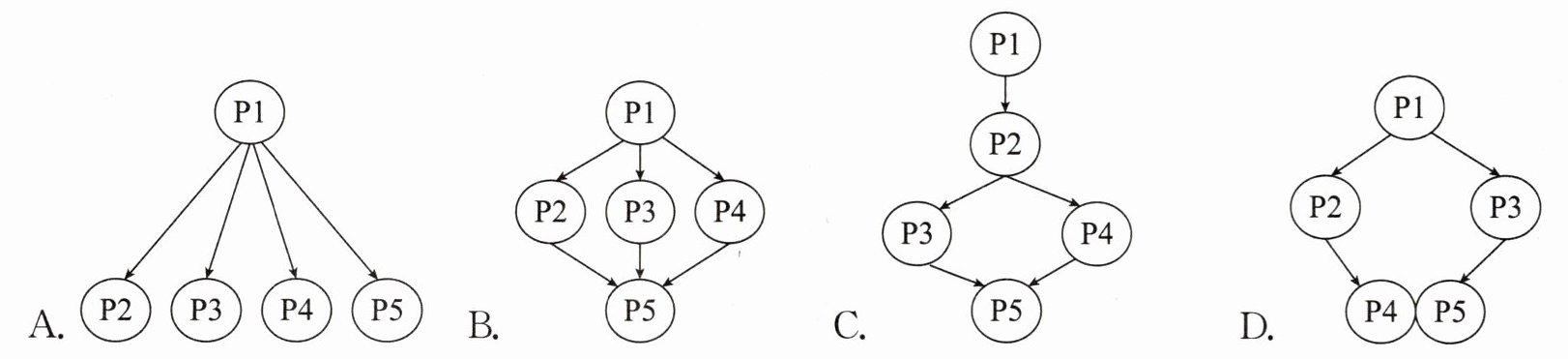
4. What's the purpose(目的) of writing the passage?
A. To tell why elephants have languages.
B. To express how smart elephants are.
C. To tell what elephants can do.
D. To tell how elephants communicate.