四、完形填空
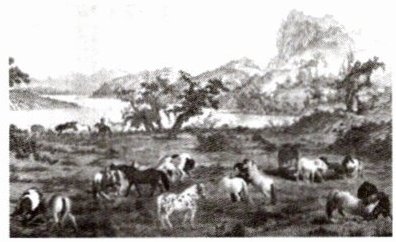
Among the most famous traditional Chinese paintings, One Hundred Horses
1 with its unique style. Surprisingly, it was created not by a Chinese artist, but by an Italian named Giuseppe Castiglione,
2 to Chinese as Lang Shining.
Castiglione was born in Milan in 1688.
3 by the goal to spread Western culture, Castiglione came to Beijing in 1715 and became a great court(宫廷)artist. He was widely famous for
4 Western and Chinese painting styles.
In 1724, Emperor Yongzheng asked him to paint this nearly 8-metre-long silk handscroll(手卷), which took him four years of hard
5 to finish.
Painting on silk was difficult since each brushstroke was permanent(永久的). So Castiglione had to practise again and again on paper first before copying his design onto silk.
6 we don't know Yongzheng's true opinion, his son Emperor Qianlong was greatly
7 with it and called it a great work of art.
As the title suggests, the painting shows about 100 horses in different lively poses. It required the artist to combine(结合)Western realism(现实主义)with Eastern painting
8 skillfully. The great mix made every object in the painting look real and lively.
This work shows a perfect balance between humans and nature, as well as Eastern and Western art. That is
9 why the painting won huge favour(喜爱)in the court and has been
10 for centuries.
(
B
) 1. A. breaks out B. stands out C. takes out D. puts out
(
A
) 2. A. familiar B. strange C. similar D. different
(
C
) 3. A. Presented B. Hidden C. Driven D. Carried
(
D
) 4. A. judging B. separating C. comparing D. mixing
(
B
) 5. A. mistakes B. efforts C. risks D. secrets
(
C
) 6. A. If B. Since C. Though D. Because
(
C
) 7. A. strict B. bored C. pleased D. careful
(
A
) 8. A. methods B. characters C. rules D. signs
(
D
) 9. A. hardly B. nearly C. seldom D. perhaps
(
C
)10. A. wasted B. stolen C. praised D. divided