Ⅴ. 阅读理解
Whether you are teaching an elementary Spanish class or passing on Spanish to your children, it is important to teach children good manners. And there are culturally proper behaviours that children need to know.
These five behaviours are considered good manners throughout Latin America. Of course, these are good manners in the USA too, but they are not given as much attention because the opposite behaviours are not considered particularly rude in Spanish-speaking countries. However, the opposite behaviours are negative and can change the impression people have of children (and adults)!
All of these good manners can be practised by children with different language levels.
Good manners to teach kids learning Spanish:
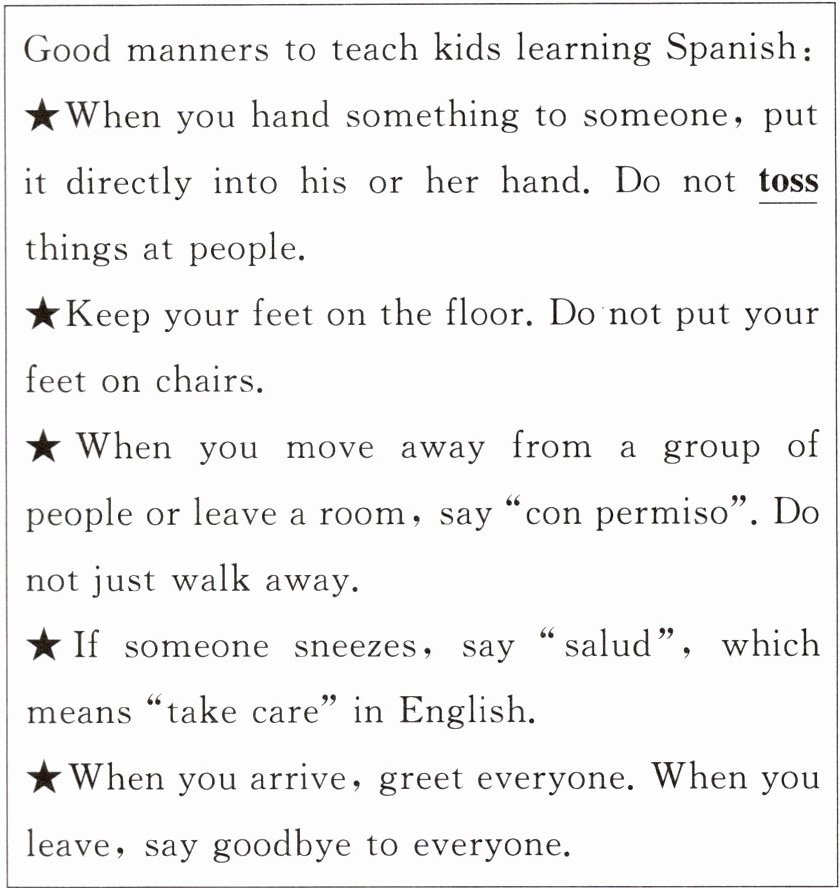
★When you hand something to someone, put it directly into his or her hand. Do not
toss things at people.
★Keep your feet on the floor. Do not put your feet on chairs.
★ When you move away from a group of people or leave a room, say “con permiso”. Do not just walk away.
★ If someone sneezes, say “salud”, which means “take care” in English.
★When you arrive, greet everyone. When you leave, say goodbye to everyone.
There are lots of resources for teaching children good manners in Spanish. Many polite behaviours also include language. Here you will find resources for teaching polite expressions, including books and a song. There are also videos that teach polite behaviours.
In my experience, kids are interested in what is considered polite behaviour in different cultures, and they want to learn to act properly. We work hard teaching them to use Spanish. It is important that they also know how to interact so that others are comfortable and they can make the most of the language they have learned.
1. The passage is probably written for
.
A. travellers who will go abroad on holiday
B. teachers who are teaching in the Spanish class
C. parents who care about their children’s manners
D. children who want to pass their Spanish tests
2. The underlined word “toss” in the passage can be replaced by “
”.
A. send
B. make
C. throw
D. look
3. According to the passage, which is considered a proper behaviour?
A. Jim keeps his feet on his friend’s chair.
B. Jim sneezes, and his friend gets angry with him.
C. Jim comes in and says good morning to his classmates.
D. Jim doesn’t say goodbye to everyone when he leaves a room.
4. The best title for the passage can be “
”.
A. Good Manners for Spanish Learners
B. The History of the Spanish Language
C. How to Behave Well in the Spanish Class
D. Some Ways of Teaching Children Spanish