零五网 › 全部参考答案› 5年中考3年模拟答案 › 2026年5年中考3年模拟九年级数学下册人教版 第95页解析答案
17. 「2025 贵州中考」如图,在四边形 $ABCD$ 中,$AD// BC$,$BD$ 是对角线.
(1) 尺规作图:请用无刻度的直尺和圆规,作线段 $BD$ 的垂直平分线,垂足为点 $O$,与边 $AD$,$BC$ 分别交于点 $E$,$F$(要求:不写作法,保留作图痕迹).
(2) 在 (1) 的条件下,连接 $BE$,$DF$,求证:四边形 $BFDE$ 为菱形.


答案:
17.解析 (1)如图所示.

(2)证明:如图所示,

$\because EF$垂直平分BD,
$\therefore BE = DE$,$∠ BOE = ∠ BOF = 90°$,$OB = OD$,
$\therefore ∠ EBD = ∠ EDB$,
$\because AD// BC$,$\therefore ∠ EDB = ∠ CBD$,$\therefore ∠ EBO = ∠ FBO$,又$\because OB = OB$,$\therefore △ EBO≌△ FBO(ASA)$,
$\therefore OE = OF$,$\therefore$四边形BFDE是平行四边形,
又$\because BE = DE$,$\therefore$四边形BFDE是菱形.
18. 「2025 江苏扬州中考」如图,在 $□ ABCD$ 中,对角线 $AC$ 的垂直平分线与边 $AD$,$BC$ 分别相交于点 $E$,$F$,连接 $AF$,$CE$.
(1) 求证:四边形 $AFCE$ 是菱形.
(2) 若 $AB = 3$,$BC = 5$,$CE$ 平分 $∠ ACD$,求 $DE$ 的长.


答案:18.解析 (1)证明:$\because EF$垂直平分AC,
$\therefore EA = EC$,$FA = FC$,$OA = OC$,$∠ AOE = ∠ COF = 90°$,
$\because$四边形ABCD是平行四边形,
$\therefore AD// BC$,$\therefore ∠ OAE = ∠ OCF$,
在$△ OAE$和$△ OCF$中,$\begin{cases} ∠ AOE = ∠ COF \\ OA = OC \\ ∠ OAE = ∠ OCF \end{cases}$,
$\therefore △ OAE≌△ OCF(ASA)$,
$\therefore EA = FC$,$\therefore EA = EC = FC = FA$,
$\therefore$四边形AFCE是菱形.
(2)$\because$四边形ABCD是平行四边形,$AB = 3$,
$\therefore CD = AB = 3$,$∠ D = ∠ B$,
$\because$四边形AFCE是菱形,$\therefore ∠ ACB = ∠ ACE$,
$\because CE$平分$∠ ACD$,$\therefore ∠ DCE = ∠ ACE = ∠ BCA$,
$\therefore △ CDE∼△ CBA$,
$\therefore \frac{DE}{AB}=\frac{CD}{BC}$,即$\frac{DE}{3}=\frac{3}{5}$,$\therefore DE = \frac{9}{5}$.
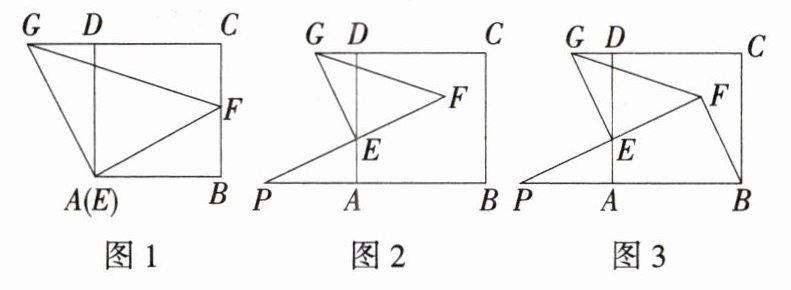
19. 「2025 甘肃中考」四边形 $ABCD$ 是正方形,点 $E$ 是边 $AD$ 上一动点(点 $D$ 除外),$△ EFG$ 是直角三角形,$EG = EF$,点 $G$ 在 $CD$ 的延长线上.
(1) 如图 1,当点 $E$ 与点 $A$ 重合,且点 $F$ 在边 $BC$ 上时,写出 $BF$ 和 $DG$ 的数量关系,并说明理由.
(2) 如图 2,当点 $E$ 与点 $A$ 不重合,且点 $F$ 在正方形 $ABCD$ 内部时,$FE$ 的延长线与 $BA$ 的延长线交于点 $P$,如果 $EF = EP$,写出 $AE$ 和 $DG$ 的数量关系,并说明理由.
(3) 如图 3,在 (2) 的条件下,连接 $BF$,写出 $BF$ 和 $DG$ 的数量关系,并说明理由.

答案:
19.解析 (1)$BF = DG$.理由如下:
$\because$四边形ABCD是正方形,
$\therefore AB = AD$,$∠ ABC = ∠ CDA = 90°$,
$\therefore ∠ FBA = ∠ GDA = 90°$.
$\because EF = EG$,点E与点A重合,$\therefore AF = AG$,
$\therefore Rt△ FBA≌ Rt△ GDA(HL)$,$\therefore BF = DG$.
(2)$AE = DG$.理由如下:
$\because$四边形ABCD是正方形,$\therefore ∠ DAB = ∠ CDA = 90°$,$\therefore ∠ EAP = ∠ GDE = 90°$.
$\because △ EFG$是直角三角形,
$\therefore ∠ GEF = 90°$,$\therefore ∠ GEP = 90°$,
$\therefore ∠ AEP + ∠ GED = ∠ DGE + ∠ GED = 90°$,
$\therefore ∠ AEP = ∠ DGE$.
$\because EP = EF$,$EF = EG$,$\therefore EP = GE$,
$\therefore △ EAP≌△ GDE(AAS)$,$\therefore AE = DG$.
(3)$BF = \sqrt{5}DG$.理由如下:
如图,过点F作$FH⊥ AB$于点H,
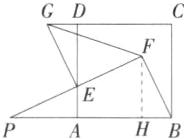
HB
$\because EA⊥ AB$,$\therefore EA// FH$,$\therefore \frac{PE}{EF}=\frac{PA}{AH}$.
$\because PE = EF$,$\therefore PA = AH$,
$\therefore EA$是$△ PFH$的中位线,$\therefore FH = 2EA = 2DG$.
由(2)知,$△ EAP≌△ GDE$,$\therefore AP = DE$,$\therefore DE = AH$,
又$\because AD = AB$,$\therefore AD - DE = AB - AH$,$\therefore EA = HB = DG$,$\therefore$在$Rt△ FHB$中,$BF = \sqrt{FH^{2}+HB^{2}}=\sqrt{(2DG)^{2}+DG^{2}}=\sqrt{5}DG$,即$BF = \sqrt{5}DG$.

上一页 下一页