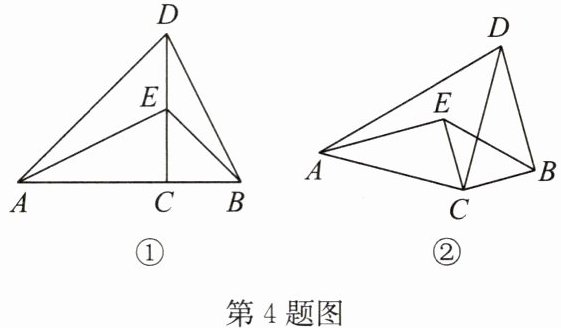
4.已知$△ ACD$和$△ BCE$都是等腰直角三角形,$∠ ACD=∠ BCE=90°$.
【初步探索】(1)如图①摆放$△ ACD$和$△ BCE$(点$A,C,B$在同一条直线上,点$E$在$CD$上),连接$AE,BD$,判断线段$AE$与$BD$的数量关系和位置关系;
【拓展延伸】(2)如图②摆放$△ ACD$和$△ BCE$,连接$AE,BD$,(1)中的结论是否仍然成立?请说明理由.
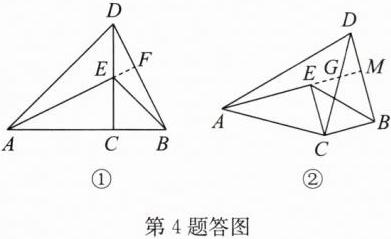
答案:(1)如答图①,延长$AE$交$BD$于点$F$.
在$△ ACE$和$△ DCB$中,$\begin{cases} AC=DC,\\ ∠ ACE=∠ DCB,\\ CE=CB, \end{cases}$
$\therefore △ ACE≌△ DCB(\mathrm{SAS})$,
$\therefore AE=BD$,$∠ CAE=∠ CDB$.
$\because ∠ CDB+∠ DBC=90°$,$\therefore ∠ CAE+∠ DBC=90°$,
$\therefore ∠ AFB=90°$,$\therefore AE⊥ BD$.
(2)(1)中的结论仍然成立,$AE=BD$,$AE⊥ BD$.理由如下:
如答图②,延长$AE$交$BD$于点$M$,交$CD$于点$G$.
$\because ∠ ACD=∠ BCE=90°$,
$\therefore ∠ ACD-∠ ECD=∠ BCE-∠ ECD$,即$∠ ACE=∠ DCB$.
在$△ ACE$和$△ DCB$中,$\begin{cases} AC=DC,\\ ∠ ACE=∠ DCB,\\ CE=CB, \end{cases}$
$\therefore △ ACE≌△ DCB(\mathrm{SAS})$,$\therefore AE=BD$,$∠ CAE=∠ CDB$.
$\because ∠ CAE+∠ AGC=90°$,$∠ AGC=∠ DGM$,
$\therefore ∠ CDB+∠ DGM=90°$,$\therefore ∠ AMD=90°$,$\therefore AE⊥ BD$.