B
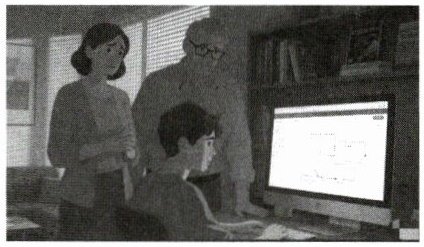
When Leon Martin asked for his parents' advice on how to become a UX designer, they both went silent. "In fact, I had no idea what he was talking about," said Anne, his mother.
Even when her 18-year-old son explained that it was something about "behind the scenes" online design, his mother was still a bit lost. "I felt like I had totally failed as a parent," she said. "My job as a parent is to open doors so my children can achieve best of their ability, but how can I do that when I don't even understand what their dreams are?"
Research has found that more than 2/3 of parents in the UK are now facing the problem that, when their children express interest in job choices, they may know nothing about them. Over 75% of parents feel it is impossible to offer their children good advice in such a fast-changing job market.
Michelle Rea did a survey of over 2,000 parents of secondary school students in the UK. She found that many parents were afraid their children would just stop talking about their career plans simply because their parents could hardly follow them. "We all know parents' opinions and suggestions play an important role in shaping their children's career dreams," she said. "But we usually depend much on our own experiences. And things have changed so much since most of us were at school."
Bryony Mathew, the writer of the Awesome Career Books, said the world was changing so
rapidly that parents should respect their children's decisions.
( )4. Why did the writer mention Leon and his parents' problems at the beginning of the passage?
A. To give the standard of failed parents.
B. To tell the importance of being a UX designer.
C. To show parents never understand their children.
D. To give an example of a common problem among parents.
(
B
)5. The underlined word "rapidly" in the last paragraph means "
".
A. slowly B. quickly C. gently D. secretly
(
A
)6. 创新考法—语篇逻辑 Which of the following is the best sentence to fill in the blank in Paragraph 3?
A. Anne is not alone. B. Anne has bad luck.
C. This is very strange. D. This is very interesting.
(
B
)7. What did Michelle Rea's survey mainly show?
A. Most of the parents in the UK were facing trouble in accepting new jobs.
B. Parents feared that their children would refuse to share their career dreams.
C. A lot of parents found it difficult to help their children with their education.
D. Children's future career depended a lot on their parents' working experiences.