零五网 全部参考答案 通城学典课时作业本答案 2026年通城学典课时作业本八年级英语下册译林版江苏专版 第55页解析答案
B)语法填空。
Why is the cat not in the Chinese zodiac(生肖)?
There is a famous Chinese folk story about this. The Jade Emperor(玉皇大帝) invited all animals to take part 1.
in
a race. The first 12 animals 2.
to finish
(finish) the race would become part of the Chinese zodiac.
At that time, the cat and the rat were good friends. When they 3.
heard
(hear) about the race, the cat said to the rat, "We should arrive early to sign up for the race, but I 4.
usually
(usual) wake up late." The rat promised to wake his friend up 5.
so
they could go together. However, on the morning of the race, the rat was so 6.
excited
(excite) when he woke up that he forgot his promise. He went directly to the gathering area for the race. The cat woke up only 7.
to find
(find) that the race was already over.
But it is only 8.
a
story. The real reason is that there were no cats in China in ancient times. Researchers say that before the Han Dynasty, China didn't have house cats. There were some descriptions of cats in China in some ancient 9.
books
(book), but they were mostly wildcats.
Nowadays it is believed that house cats have 10.
appeared
(appear) in China since the Eastern Han Dynasty. But by that time, the animals of the Chinese zodiac had already been chosen.
答案:1. in 2. to finish 3. heard 4. usually 5. so 6. excited 7. to find 8. a 9. books 10. appeared
解析:
【分析】
拿到这篇语法填空后,首先通读全文,明确语篇围绕“中国生肖中没有猫的原因”展开,民间故事部分用一般过去时叙事,后半部分是客观史实说明。接下来逐空结合句子结构、固定搭配、词性规则、时态逻辑推导答案:
1. 第一空看到空前的take part,优先联想对应的固定短语;
2. 第二空前有序数词修饰的名词animals,回忆非谓语作后置定语的特殊规则;
3. 第三空是故事部分的谓语,匹配全文叙事的过去时态即可;
4. 第四空后是动词短语wake up,需要副词修饰动词;
5. 第五空连接两个完整句子,判断前后的顺承逻辑选择对应连词;
6. 第六空作表语修饰有生命主体rat的主观感受,选择对应ed结尾形容词;
7. 第七空前有only,回忆表出乎意料结果的固定非谓语结构;
8. 第八空后是可数名词story,泛指“一个故事”选择对应不定冠词;
9. 第九空前有some修饰,可数名词要变为复数形式;
10. 第十空前有助动词have,匹配现在完成时的结构要求填过去分词。
【解析】
1. 固定搭配take part in意为“参加”,是固定短语,故填in。
2. 当名词被序数词修饰时,后续非谓语要用不定式作后置定语,此处表示“完成比赛的前12只动物”,故填to finish。
3. 民间故事的叙事发生在过去,句子用一般过去时,hear的过去式为heard,故填heard。
4. 此处需要副词修饰动词短语wake up,usual的副词形式是usually,意为“通常”,故填usually。
5. 前后句逻辑为:老鼠承诺叫醒朋友,这样他们就能一起出发,表顺承结果用连词so,故填so。
6. 此处修饰主语the rat的主观感受,表达“感到兴奋的”,修饰有生命主体的感受用excited,故填excited。
7. 固定结构only to do sth. 表示“结果却……”,用来引出人意料的结果,符合“猫醒后发现比赛已经结束”的语境,故填to find。
8. 此处泛指“这只是一个故事”,story是辅音音素开头的可数名词单数,用不定冠词a,故填a。
9. 空前有some修饰,可数名词book要变为复数形式books,故填books。
10. 本句为现在完成时结构“have+过去分词”,appear的过去分词是appeared,故填appeared。
【答案】
1. in 2. to finish 3. heard 4. usually 5. so 6. excited 7. to find 8. a 9. books 10. appeared
【知识点】
词形转换,非谓语动词,固定搭配
【点评】
本题选取中国传统生肖文化相关的趣味语篇,考察的都是中学阶段核心高频语法考点,大部分空可通过基础时态、词性规则直接推导,仅少数非谓语特殊结构考点需要学生有一定的知识积累,整体难度适中,适合巩固基础语法应用能力。
【难度系数】
0.75
七、(2025·南京市玄武区期中改编)任务型阅读。(1~8空每空1分,第9空2分,共10分)
The Feynman Technique was developed by Nobel Prize-winning physicist Richard Feynman. It's a study method that helps students learn by teaching others.
The Feynman Technique has been one of the most effective(有效的) study methods for many years. For one thing, it helps students really understand something instead of just memorizing information. Plus, unlike traditional study methods like rereading textbooks or reviewing notes, it pushes students to take a more active part in the learning process.
If you want to use the Feynman Technique to study better, follow these steps.
To begin with, choose a topic you want to learn, including sub-topics. If not, you'll end up jumping between topics without developing a deeper understanding of any of them.
The second step is the heart of the Feynman Technique: make the explanation(解释) simple enough to be understood by a sixth-grade student. This requires you to help the child understand by using the simplest and clearest language. This step helps divide topics that are difficult to understand into their most basic parts.
Next, review your explanation and try to find any area where you felt that you couldn't explain the topic in a simple way. When possible, it can be very helpful to get advice from someone whose understanding is similar to that of a sixth-grader.
The fourth step is to improve your explanation, using the information collected from the third step.
Finally, follow the steps over and over again. The Feynman Technique works best with repetition, and that is why going through all the prior(先前的) steps just once is usually not enough to fully understand the topic.
Once you're confident you've learned the topic well, it's time to give yourself a prize. Perhaps, like me, enjoy a nice cup of coffee.
根据短文内容,完成下面的表格。(前8个小题每空只能填一个单词,最后一小题词数不限)
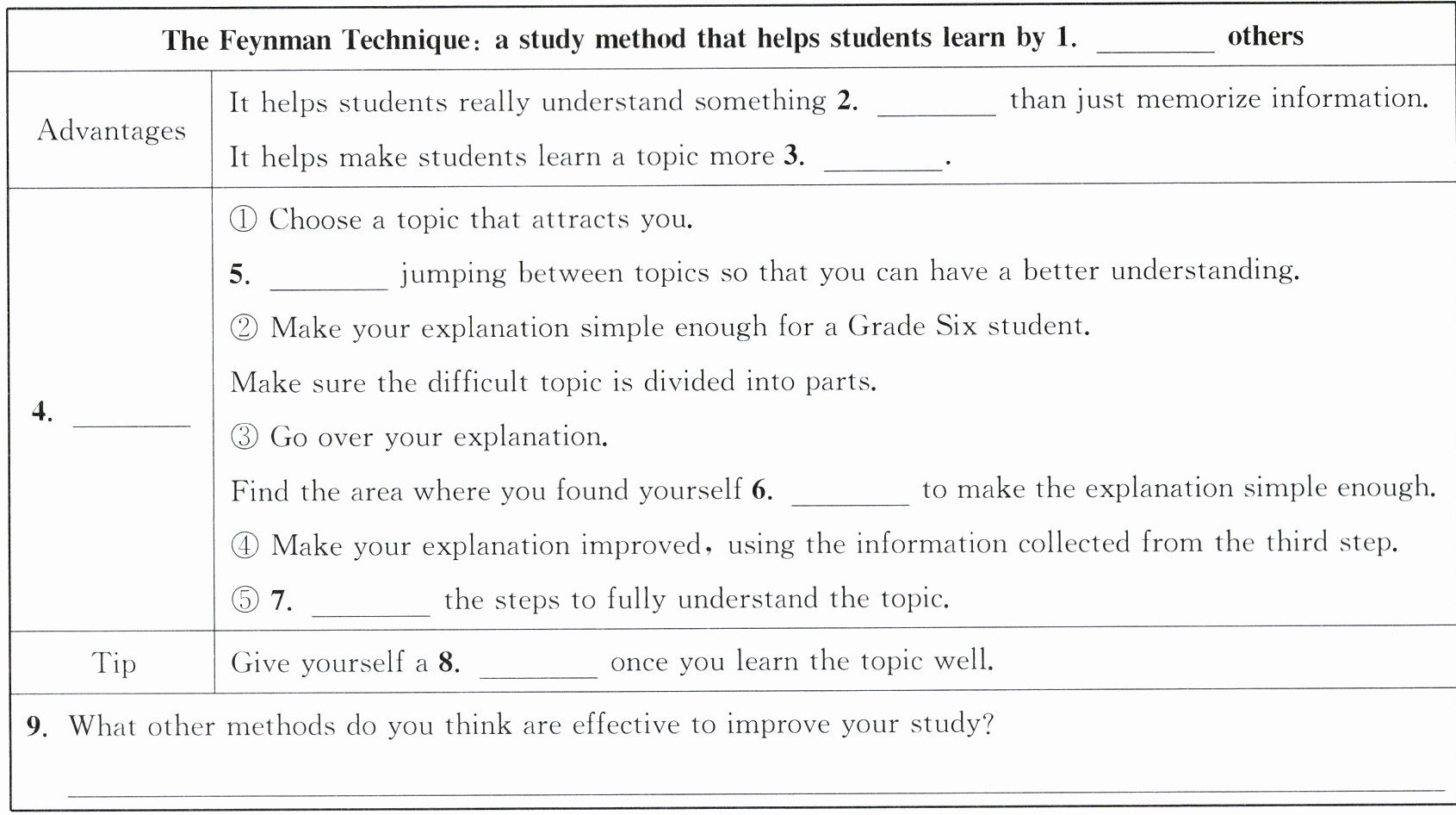

答案:1. teaching 2. rather 3. actively 4. Steps 5. Avoid 6. unable 7. Repeat 8. prize 9. I think making mind maps to organize knowledge and doing regular practice tests are effective. (言之有理即可)
解析:
【分析】
这是一篇信息匹配类的任务型阅读题,解题思路如下:1. 先通读全文,明确文章介绍的费曼学习法的定义、优势、操作步骤和小贴士的整体框架,和表格的结构一一对应;2. 逐个定位每个空格对应的原文原句,注意前8个空要求每空仅填1个单词,遇到原文的短语要转换为表格里匹配的搭配形式,同时注意词性、大小写的正确变化;3. 最后开放题结合日常学习常识,写出合理的有效学习方法即可,保证表述通顺符合逻辑。
【解析】
1. 定位原文第一段最后一句"It's a study method that helps students learn by teaching others",by后接动名词,直接得到答案teaching。
2. 定位原文第二段"it helps students really understand something instead of just memorizing information",表格空后是than,固定搭配rather than和instead of含义一致,故填rather。
3. 定位原文第二段"it pushes students to take a more active part in the learning process",表格中修饰动词learn需要用副词,active的副词形式是actively,表达更主动地学习主题,故填actively。
4. 该栏下方罗列了费曼学习法的5个操作流程,对应原文第三段"follow these steps",该空是栏目标题,填Steps,首字母大写。
5. 定位原文第四段"If not, you'll end up jumping between topics without developing a deeper understanding of any of them",说明要避免在不同主题间跳转,空后是jumping,祈使句开头,填Avoid,符合Avoid doing sth的结构,首字母大写。
6. 定位原文第六段"try to find any area where you felt that you couldn't explain the topic in a simple way",can't do sth等同于be unable to do sth,故填unable。
7. 定位原文倒数第二段"follow the steps over and over again",也就是重复这些步骤才能完全掌握主题,祈使句开头填Repeat,首字母大写。
8. 定位原文最后一段"Once you're confident you've learned the topic well, it's time to give yourself a prize",直接得到答案prize。
9. 该题为开放性试题,只要写出合理有效的学习方法,表述通顺即可。
【答案】
1. teaching 2. rather 3. actively 4. Steps 5. Avoid 6. unable 7. Repeat 8. prize 9. I think making mind maps to organize knowledge and doing regular practice tests are effective. (言之有理即可)
【知识点】
任务型阅读,细节定位,词形转换
【点评】
本题属于典型的表格型任务型阅读,大部分空格可以通过原文细节直接定位得到答案,少数空格需要结合固定搭配、词性转换完成,既考察学生的信息检索能力,最后开放题也引导学生结合自身学习经验思考适合自己的学习方法,整体难度梯度平缓。
【难度系数】
0.7
上一页 下一页