【分析】
(1) 要证D是PQ中点,即证PD=DQ,考虑构造全等三角形证明线段相等:过P作PF//QC交AB于F,结合等边△ABC的性质可证△AFP为等边三角形,得PF=AP;由P、Q速度相同可得BQ=AP,即BQ=PF,再结合平行线的内错角相等、对顶角相等,用AAS证△DBQ≌△DFP,即可得PD=DQ。
(2) 已知∠BQD=30°,结合等边三角形内角为60°,利用外角性质可推出∠BDQ=30°,得BD=BQ,再结合(1)的全等结论和等边三角形的边长关系,即可求出AP的长度。
(3) 判断ED长度是否变化,可利用(1)的结论推导:等边△AFP中PE⊥AB,由三线合一得AE=EF;由△DBQ≌△DFP得BD=DF,因此DE可转化为AB长度的一半,为定值,不随动点运动变化。
【解析】
(1) 证明:过点P作$PF// QC$ 交 AB 于点 F,如答图。
则$△ AFP$ 是等边三角形,$∠ DQB=∠ DPF$。
$\because$ 点 P,Q 同时出发,速度相同,即 $BQ=AP$,
$\therefore BQ=PF$。
在$△ DBQ$ 和$△ DFP$ 中,$\begin{cases} ∠ DQB=∠ DPF,\\ ∠ QDB=∠ PDF,\\ BQ=FP, \end{cases}$
$\therefore △ DBQ≌ △ DFP(\mathrm{AAS}),\therefore DQ=DP$,即 D 是线段PQ 的中点。
(2) 解:$\because △ DBQ≌ △ DFP,\therefore BD=DF$。
$\because ∠ DBC=∠ BQD+∠ BDQ=60°,∠ BQD=30°$,
$\therefore ∠ BQD=∠ BDQ=∠ FDP=∠ FPD=30°$,
$\therefore BD=DF=PF=FA=\frac{1}{3}AB=2,\therefore AP=2$。
(3) 解:线段 ED 的长不发生变化。 由(2)知 $BD=DF$,
由(1)知$△ AFP$ 是等边三角形,$PE⊥ AB,\therefore AE=EF$,
$\therefore DE=DF+EF=\frac{1}{2}BF+\frac{1}{2}FA=\frac{1}{2}AB=3$。
【答案】
(1) D是线段PQ的中点,证明见解析;
(2) $AP=2$;
(3) 线段ED的长不发生变化,$ED=3$。
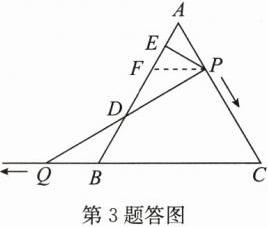
第3题答图
【知识点】
等边三角形性质,全等三角形判定与性质,动点定值计算
【点评】
本题是等边三角形与动点结合的综合题,三个小问梯度明显,第一问的辅助线构造是解题关键,后两问可沿用前一问的结论推导,能有效考察对几何性质的综合运用能力和动态问题的分析能力。
【难度系数】
0.6