4. 如图,$∠ A=∠ B=90°$,点E在AB上,$AE=BC$,$DE=CE$。
(1)$\mathrm{Rt}△ ADE$与$\mathrm{Rt}△ BEC$全等吗?说明理由。
(2)$△ CDE$是直角三角形吗?说明理由。
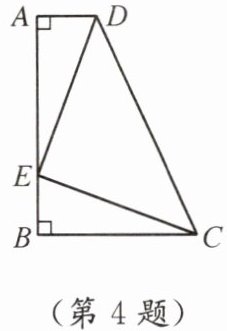
答案:解:(1) $\mathrm{Rt}△ ADE$与$\mathrm{Rt}△ BEC$全等,理由如下:
$\because ∠ A = ∠ B = 90°$,
$\therefore △ ADE$和$△ BEC$都是直角三角形。
在$\mathrm{Rt}△ ADE$和$\mathrm{Rt}△ BEC$中,
$\begin{cases} DE = CE \\ AE = BC \end{cases}$
$\therefore \mathrm{Rt}△ ADE ≌ \mathrm{Rt}△ BEC (\mathrm{HL})$。
(2) $△ CDE$是直角三角形,理由如下:
$\because \mathrm{Rt}△ ADE ≌ \mathrm{Rt}△ BEC$,
$\therefore ∠ AED = ∠ BCE$。
$\because$ 在$\mathrm{Rt}△ BEC$中,$∠ B = 90°$,
$\therefore ∠ BCE + ∠ BEC = 90°$,
$\therefore ∠ AED + ∠ BEC = 90°$。
$\because$ 点$E$在$AB$上,$∠ AED + ∠ DEC + ∠ BEC = 180°$,
$\therefore ∠ DEC = 180° - (∠ AED + ∠ BEC) = 90°$,
$\therefore △ CDE$是直角三角形。
解析:
【分析】
(1)判断两个直角三角形是否全等,首先明确两个三角形都是直角三角形,已知斜边DE=CE,一组直角边AE=BC,符合直角三角形全等的HL判定条件,因此可证明二者全等。
(2)要判断△CDE是否为直角三角形,只需证明其有一个内角为90°即可。借助第一问的全等结论得到对应角相等,结合直角三角形两锐角互余的性质进行角的等量代换,再利用平角为180°的性质,即可求出∠DEC=90°,从而得出结论。
【解析】
(1) $\mathrm{Rt}△ ADE$与$\mathrm{Rt}△ BEC$全等,理由如下:
$\because ∠ A = ∠ B = 90°$,
$\therefore △ ADE$和$△ BEC$都是直角三角形。
在$\mathrm{Rt}△ ADE$和$\mathrm{Rt}△ BEC$中,
$\begin{cases} DE = CE \\ AE = BC \end{cases}$
$\therefore \mathrm{Rt}△ ADE ≌ \mathrm{Rt}△ BEC (\mathrm{HL})$。
(2) $△ CDE$是直角三角形,理由如下:
$\because \mathrm{Rt}△ ADE ≌ \mathrm{Rt}△ BEC$,
$\therefore ∠ AED = ∠ BCE$。
$\because$ 在$\mathrm{Rt}△ BEC$中,$∠ B = 90°$,
$\therefore ∠ BCE + ∠ BEC = 90°$,
$\therefore ∠ AED + ∠ BEC = 90°$。
$\because$ 点$E$在$AB$上,$∠ AED + ∠ DEC + ∠ BEC = 180°$,
$\therefore ∠ DEC = 180° - (∠ AED + ∠ BEC) = 90°$,
$\therefore △ CDE$是直角三角形。
【答案】
(1)$\mathrm{Rt}△ ADE ≌ \mathrm{Rt}△ BEC$;(2)$△ CDE$是直角三角形
【知识点】
HL判定全等、全等三角形的性质、直角三角形的判定
【点评】
本题是全等三角形的基础应用题,解题核心是先利用HL定理证明直角三角形全等,再通过角的等量代换推导角的度数,逻辑链条清晰,侧重对基础定理应用能力的考查。
【难度系数】
0.7
5. 如图,在$△ ABC$中,$BD$,$CE$分别是边$AC$和$AB$上的高,$BD=CE$. 求证:$BE=CD$.
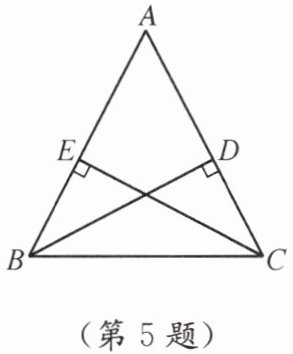
答案:证明:
∵ BD,CE分别是边AC和AB上的高,
∴ ∠BEC = ∠CDB = 90°,
∴ △BCE和△CBD都是直角三角形。
在Rt△BCE和Rt△CBD中,
$\{\begin{array}{l}BC = CB \\CE = BD\end{array} $
∴ Rt△BCE ≌ Rt△CBD(HL),
∴ BE = CD。
解析:
【分析】
要证明$BE=CD$,可通过证明两条线段所在的三角形全等推导。首先观察图形,$BE$属于$Rt△ BCE$,$CD$属于$Rt△ CBD$;已知$BD$、$CE$是$△ ABC$的高,可判断两个三角形均为直角三角形,再结合已知条件$BD=CE$,以及两个三角形的公共边$BC=CB$,就能用直角三角形全等的HL判定定理证明两三角形全等,最后根据全等三角形对应边相等即可得证。
【解析】
证明:
∵ $BD$,$CE$分别是边$AC$和$AB$上的高,
∴ $∠ BEC = ∠ CDB = 90°$,
∴ $△ BCE$和$△ CBD$都是直角三角形。
在$Rt△ BCE$和$Rt△ CBD$中,
$\begin{cases}BC = CB \\CE = BD\end{cases}$
∴ $Rt△ BCE ≌ Rt△ CBD$(HL),
∴ $BE = CD$。
【答案】
已证得$BE=CD$,证明过程如上。
【知识点】
直角三角形全等的判定;全等三角形的性质;三角形高的定义
【点评】
本题是基础几何证明题,核心考查“证线段相等可先证其所在三角形全等”的解题思路,解题时只需定位待证线段所属的三角形,结合已知条件寻找全等判定依据即可求解。
【难度系数】
0.8
6. 如图,在$△ ABC$中,$AD⊥ BC$,垂足为$D$,点$E$在边$AC$上,$AD$,$BE$相交于点$H$,且$BH=AC$,$DH=DC$. $BE$与$AC$有怎样的位置关系?证明你的结论.
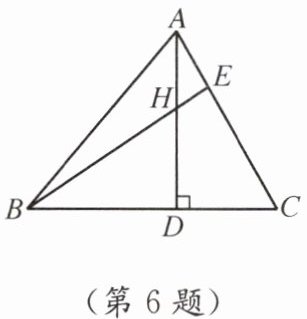
答案:证明:$BE⊥ AC$,证明如下:
$\because AD⊥ BC$,
$\therefore ∠ ADB = ∠ ADC = 90°$,
$\therefore △ BDH$和$△ ADC$都是直角三角形。
在$\mathrm{Rt}△ BDH$和$\mathrm{Rt}△ ADC$中,
$\begin{cases} BH = AC \\ DH = DC \end{cases}$
$\therefore \mathrm{Rt}△ BDH ≌ \mathrm{Rt}△ ADC(\mathrm{HL})$,
$\therefore ∠ HBD = ∠ CAD$。
$\because$ 在$\mathrm{Rt}△ ADC$中,$∠ CAD + ∠ C = 90°$,
$\therefore ∠ HBD + ∠ C = 90°$,
$\therefore$ 在$△ BEC$中,$∠ BEC = 180° - (∠ HBD + ∠ C) = 90°$,
$\therefore BE⊥ AC$。
解析:
【分析】
要判断BE与AC的位置关系,可先猜想为垂直,即需证明$∠ BEC=90°$。首先结合已知$AD⊥ BC$,可得$△ BDH$和$△ ADC$都是直角三角形;题中给出斜边$BH=AC$、直角边$DH=DC$,符合直角三角形全等的HL判定条件,可先证这两个直角三角形全等;再利用全等三角形对应角相等的性质得到$∠ HBD=∠ CAD$,结合直角三角形两锐角互余的性质做角的等量代换,即可推出$∠ HBD+∠ C=90°$,最终根据三角形内角和得到$∠ BEC=90°$,证明垂直。
【解析】
证明:$BE⊥ AC$,证明如下:
$\because AD⊥ BC$,
$\therefore ∠ ADB = ∠ ADC = 90°$,
$\therefore △ BDH$和$△ ADC$都是直角三角形。
在$\mathrm{Rt}△ BDH$和$\mathrm{Rt}△ ADC$中,
$\begin{cases} BH = AC \\ DH = DC \end{cases}$
$\therefore \mathrm{Rt}△ BDH ≌ \mathrm{Rt}△ ADC(\mathrm{HL})$,
$\therefore ∠ HBD = ∠ CAD$。
$\because$ 在$\mathrm{Rt}△ ADC$中,$∠ CAD + ∠ C = 90°$,
$\therefore ∠ HBD + ∠ C = 90°$,
$\therefore$ 在$△ BEC$中,$∠ BEC = 180° - (∠ HBD + ∠ C) = 90°$,
$\therefore BE⊥ AC$。
【答案】
$BE⊥ AC$
【知识点】
HL全等判定、全等三角形的性质、直角三角形两锐角互余
【点评】
本题是全等三角形与垂直判定的综合基础题,解题核心是先利用HL定理证明直角三角形全等,再通过角的等量代换推导得出夹角为$90°$,需熟练掌握直角三角形全等的判定条件,以及角之间的互余转换技巧。
【难度系数】
0.7
7. 如图,在$Rt△ ABC$中,$∠ C=90°$,$AC=10$,$BC=5$,过点A作$QA⊥ AC$,垂足为A,点P,Q分别在边AC和射线AQ上运动,运动过程中保持$PQ=AB$.点P运动到线段AC上什么位置时,点A,P,Q组成的三角形与$Rt△ ABC$全等?
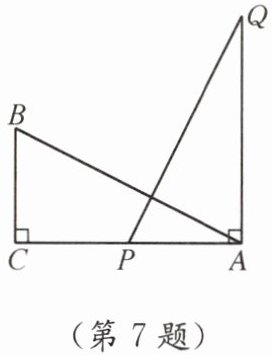
答案:解:
∵ ∠C=90°,QA⊥AC,
∴ ∠PAQ=90°,
即△ABC和△PQA都是直角三角形。
分两种情况讨论:
① 当AP=BC=5时,
在Rt△ABC和Rt△QPA中,
$\{\begin{array}{l} AB=QP \\ BC=PA \end{array} $
∴ Rt△ABC ≌ Rt△QPA(HL),
此时AP=5,点P为AC的中点。
② 当AP=AC=10时,
在Rt△ABC和Rt△PQA中,
$\{\begin{array}{l} AB=PQ \\ AC=PA \end{array} $
∴ Rt△ABC ≌ Rt△PQA(HL),
此时AP=10,点P与点C重合。
综上,当点P运动到AC的中点,或与点C重合时,△APQ与Rt△ABC全等。
解析:
【分析】
首先由已知条件可判断△ABC和△APQ均为直角三角形,且斜边AB=PQ,根据直角三角形全等的HL判定规则,只需再满足一组直角边对应相等即可判定两三角形全等。由于未明确两三角形直角边的对应关系,需分两种情况讨论:①AP与BC为对应边;②AP与AC为对应边,分别计算AP的长度即可确定点P的位置。
【解析】
∵ ∠C=90°,QA⊥AC,
∴ ∠PAQ=90°,即△ABC和△PQA都是直角三角形。
分两种情况讨论:
① 当AP=BC=5时,
在Rt△ABC和Rt△QPA中,
$\{\begin{array}{l} AB=QP \\ BC=PA \end{array} $
∴ Rt△ABC ≌ Rt△QPA(HL),
此时AP=5,点P为AC的中点。
② 当AP=AC=10时,
在Rt△ABC和Rt△PQA中,
$\{\begin{array}{l} AB=PQ \\ AC=PA \end{array} $
∴ Rt△ABC ≌ Rt△PQA(HL),
此时AP=10,点P与点C重合。
综上,当点P运动到AC的中点,或与点C重合时,△APQ与Rt△ABC全等。
【答案】
当点P运动到AC的中点,或与点C重合时,△APQ与Rt△ABC全等。
【知识点】
直角三角形全等的HL判定;分类讨论思想
【点评】
本题考查直角三角形全等的判定,解题的关键是明确在未给出对应边关系时,要分情况讨论所有可能的对应方式,避免漏解。
【难度系数】
0.7